Will the Final Result Match the Digital Smile Preview?
Will the final result match the digital preview? Not exactly. What a smile preview can promise a patient, what it can't, and why saying so helps close.
Will the final result match the digital preview?
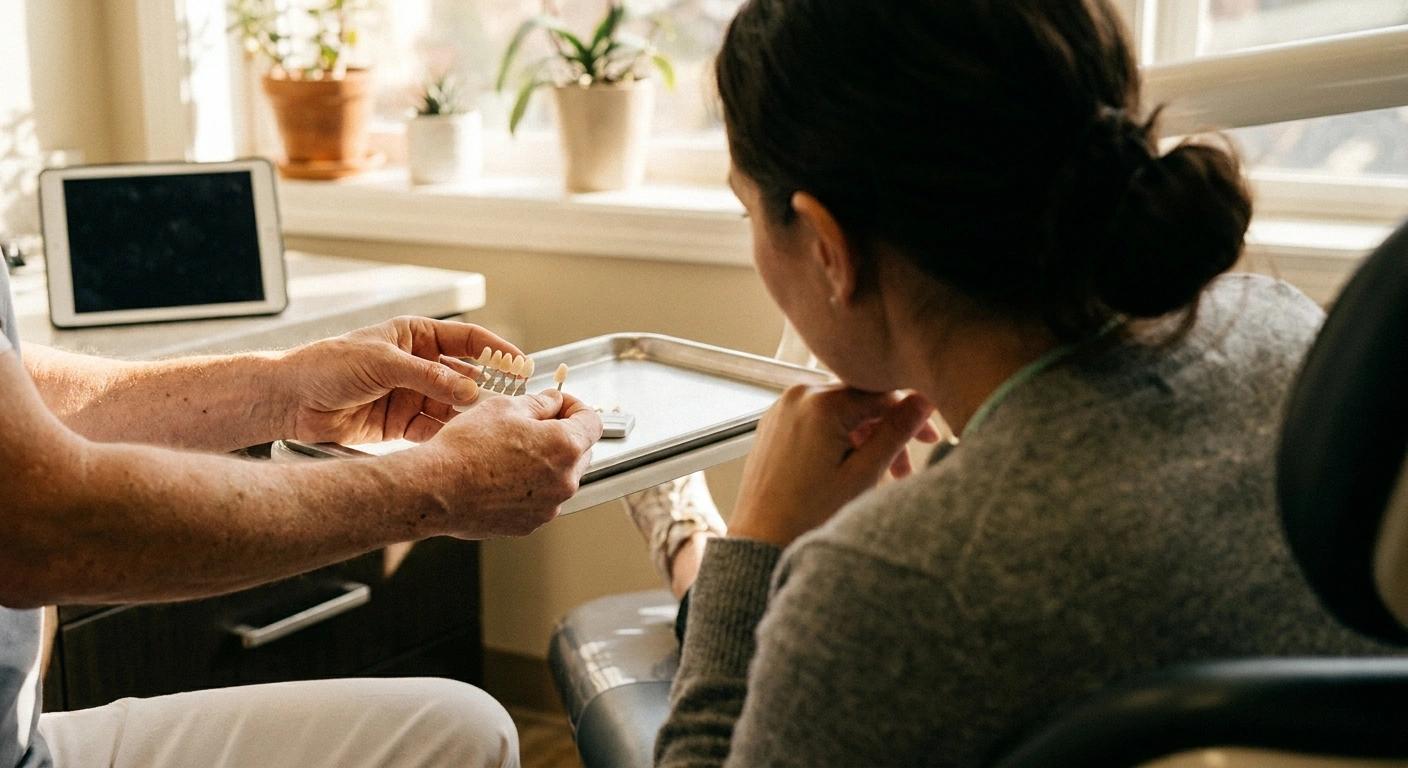
Not exactly. A digital preview shows the direction of a smile on the patient's own face, while porcelain, light, gum tissue and the clinical exam all shape the finished result. A preview is a conversation tool, and the dentist still decides what is possible.
That answer sounds like a weakness. In the operatory it works the other way. The patient who hears what the picture is, and what it is not, has one less reason to doubt everything else you say in the consult.
The hard part is the balance. You need a preview strong enough to move someone toward a high-ticket yes, without letting the picture turn into a promise. This post covers why the gap exists, why patients read an image as a guarantee, and where the honest sentence fits in the close.
Why does a finished smile differ from the image?
A preview is a picture of an intention. A restoration is a physical object, placed in a living mouth, by people making clinical decisions along the way. Four things separate the two.
- Material and light. Porcelain transmits and reflects light in ways a screen does not. The same shade reads differently under the operatory lamp, at a window and in a restaurant.
- Gum tissue. The gumline frames every tooth. A picture can suggest a frame, but the tissue has its own health, shape and healing.
- Bite and tooth position. Function can limit length, thickness and placement, however good a given shape looks from the front.
- What the exam finds. Decay, gum disease or a bite problem has to be handled first, and any of them can change the plan.
Clinics say this to patients in plain words. One clinic's patient FAQ, read on November 9, 2026, answers this exact question with "Not exactly," and goes on to name porcelain, light and gums as the variables a screen cannot show. That is a good model for tone: short, unbothered and specific.
The research is candid too. A 2026 paper in the Journal of Prosthodontic Research on Motion-DSD, an AI-assisted dynamic smile design workflow closes by saying that "further investigations are warranted to quantitatively validate the simulation accuracy" (fetched November 9, 2026). That line is about one workflow, and it should not be stretched to cover every tool. It does show that the people building these methods do not call them finished predictions, and neither should a practice. A separate study compared an AI design tool with a conventional one on ten cases, and we walk through what that AI smile design accuracy study measured.
Scan-based design has the same limit. 3Shape's blog on virtual smile design describes combining photographs and intraoral scans in design software (fetched November 9, 2026). More inputs change how a design gets made. The porcelain, the gums and the exam are still ahead of it.
Why do patients treat a preview like a promise?
Because it is their own face. A before-and-after gallery shows what happened to someone else, and the patient can keep their distance from it. A preview of their own smile feels like a photo from the future.
That feeling is why a preview moves people, and we have written about why patients say yes after seeing a preview. It is also why the framing matters. The same image that makes a cosmetic case feel real can plant a very specific expectation, down to the exact edge of a front tooth.
Nobody in the room intends that. The patient is not being unreasonable when they remember the picture, and the dentist is not misleading anyone when they show it. The expectation forms in the gap between what was shown and what was said. That gap belongs to the practice, because the practice is the only side that knows what the image leaves out.
Patients often arrive with the question already forming. It tends to surface alongside what patients ask first in a smile makeover consult: what will it cost, how long will it take, and will it really look like that. Treat the third one as seriously as the first two.
How should a practice frame a preview without overpromising?
Teach your team three ideas, and let each person say them in their own voice.
Say what the image is before you show it. Framing lands before the emotional moment, and it rarely lands after. Once the patient has seen themselves, they stop listening for a while, so any caveat added then sounds like backpedaling.
Separate the look from the clinical plan. The preview answers "do I want this?" The exam answers "can we do this, and how?" Patients handle those as two questions without any trouble when you present them as two questions. They get confused when one picture is asked to answer both.
Put the check step in the conversation. Where the dentist uses a mock-up or provisionals, mention early that the patient will get to try the design in the mouth before anything is final. The preview then becomes the first step in a process with a checkpoint, instead of a finish line drawn on a screen.
If you want the broader view of how these conversations go, see our piece on showing a patient what veneers will look like. The exact wording belongs to your practice, and it should sound like the person saying it.
Does honesty about the preview hurt the close?
The argument here is about cost. The honest sentence takes a few seconds in the room. The conversation it prevents, with a patient holding a screenshot at delivery and comparing it to their finished teeth, can take far longer and cost a referral.
We should be plain about the evidence. Smile PreVue has no measured data on whether this framing changes acceptance, and no published study we read proves a lift. So we will not put a percentage on it.
What we can offer is the reasoning. A cosmetic case is a large decision made on trust. Patients who say "I want to think about it" are often unsure whether they can believe what they were told. A dentist who volunteers the limits of their own tool is giving the patient a reason to believe the rest, including the parts that are good news.
How can a practice catch a bad preview before the patient sees it?
Framing covers the honest gap between a good preview and a finished smile. A distorted image is a different problem, and it is the easy overpromise to prevent.
Smile PreVue turns one patient photo into a photorealistic veneer or whitening preview in about 20 to 30 seconds, with 20+ VITA shades, on an iPad or in a desktop browser. A Fidelity Score then grades every preview. A second AI model compares it against the patient's own photo and the requested treatment, and the clinical team sees Excellent, Good or Review on the patient record.
Be clear on what that score is. It measures the image against the photo and the treatment. It is not a clinical prediction, not a promise about the finished restoration, and it comes from an AI model, not a person. The patient never sees it. A preview flagged Review names the problem and can be regenerated with that correction, and earlier attempts stay on the patient record.
You can read more about how accurate AI smile simulations are and what Smile PreVue does beyond the preview. Processing is HIPAA-compliant under the Google Cloud BAA on Vertex AI. There is one plan: $149.00 per provider per month or $1,199 per year on the web, and $149.99 per month in the App Store.
Frequently asked questions
Is a smile preview a guarantee? No. It shows the direction of a possible result. The finished smile depends on materials, tissue, bite and the clinical exam, and the dentist decides what is possible.
Should the patient get a copy of the preview? Yes, as a discussion aid, labeled as a preview. Smile PreVue can share it by email, by text with the patient's double opt-in, or as a branded PDF report.
Does a preview replace a mock-up or an exam? No. A preview starts the conversation. The exam decides what can be done, and a mock-up or provisionals, where the dentist uses them, let the patient try the design in the mouth.
Can I try Smile PreVue first? Yes. There is a 3-day free trial with no card on the web and 3 simulations a day, or you can download the iOS app.
See where the preview fits in your consult
Show the smile, say what it is, and keep the close honest: start a 3-day web trial with no card or download the app from the App Store, whichever suits your practice.
More from the Blog
Virtual Dental Consultation for Cosmetic Cases: What Works
A virtual dental consultation can start a cosmetic case, not finish it. What a remote consult shows, what needs the chair, and where a preview fits.
Case AcceptanceDoes Smile Simulation Increase Case Acceptance?
Does smile simulation increase case acceptance? Vendors claim 38% to triple. Here is what the research shows and when a preview helps a patient decide.
Case AcceptanceDigital Smile Analysis vs Smile Simulation: What Differs
What is digital smile analysis, and how is it different from a smile simulation? A plain guide for dentists on what each does before a cosmetic consult.