Digital Smile Analysis vs Smile Simulation: What Differs
What is digital smile analysis, and how is it different from a smile simulation? A plain guide for dentists on what each does before a cosmetic consult.
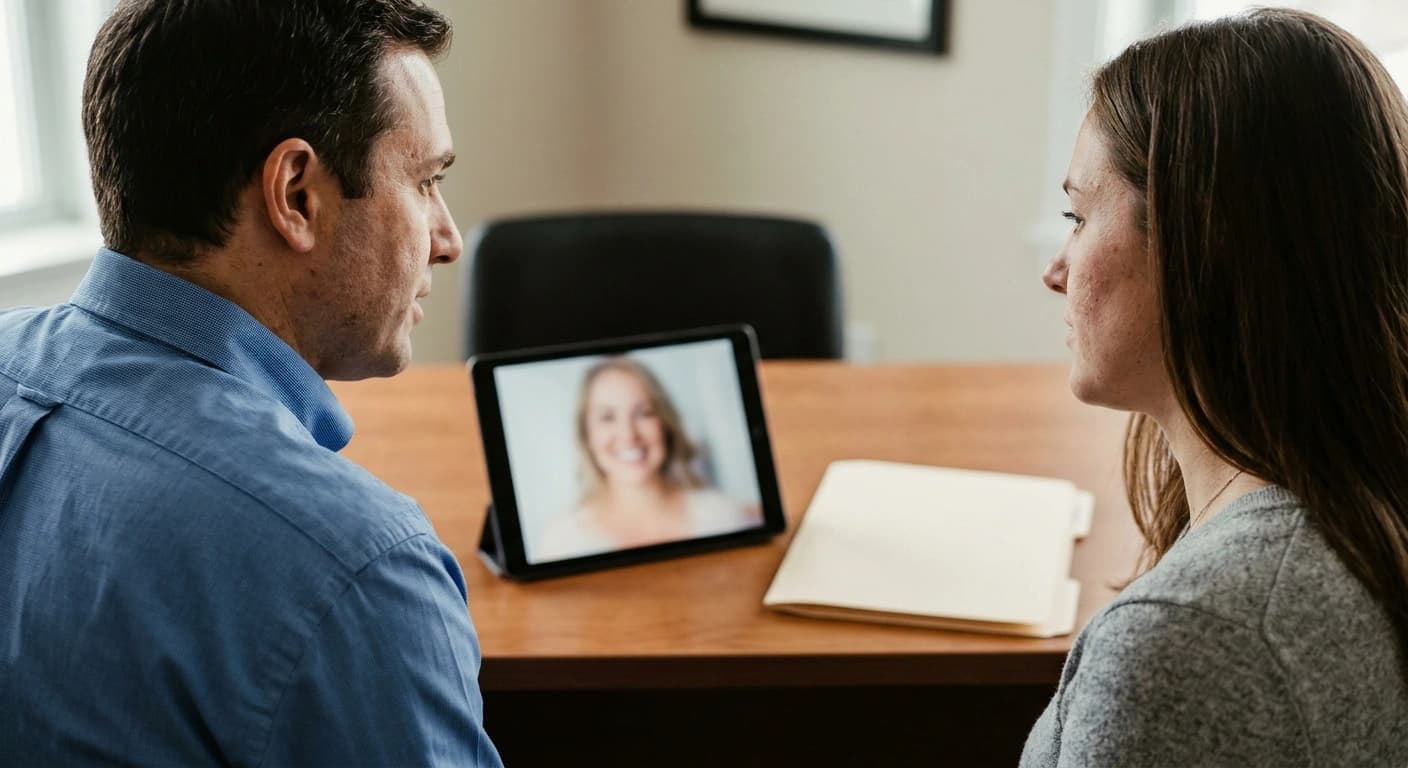
Digital smile analysis is the clinician's measured review of how a smile sits on the face: the display zone, the smile arc, incisor exposure, the midline and tooth proportions, usually worked out on photos. A smile simulation is something else. It is the picture the patient sees of their own face with the new smile, and its job is to help a person decide, not to plan the case.
Both matter, and they are easy to blur together. When a practice treats the analysis as the thing that will convince the patient, it often ends up with a careful plan and a patient who still says "I want to think about it." This guide separates the two jobs and shows where each one belongs in a cosmetic consult.
What is digital smile analysis?
Smile analysis is the diagnostic step. The dentist studies the patient's face and teeth, usually on a set of standardized photos, and decides what an ideal result should look like for that person.
A 2022 review titled "Digital Smile Design" (Thomas and colleagues, Journal of Pharmacy and Bioallied Sciences, read on PubMed Central on October 12, 2026) lays out what that review covers. In its words, the work starts in the display zone, the space formed by the upper and lower lips where the teeth and gums show. The review lists the soft-tissue parts of that zone as lip thickness, inter-commissural width, the inter-labial gap, the smile index and the gingival architecture.
From there it moves to the teeth themselves:
- The smile arc, the curve formed by the incisal edges of the upper front teeth.
- Incisor display. The review says that when smiling, around 2 mm of the upper incisors along with the interdental papilla should be visible. Too much exposure shows the gums as a gummy smile, and too little flattens the philtrum.
- Landmarks such as the dental midline, the crown length of the incisors and canines, zenith points, axial inclinations, papilla exposure and contacts.
- Proportions. The review describes how far dentistry has gone in putting numbers on the ideal tooth, from the golden ratio to other proportion systems and esthetic gauges.
The same review places this work inside facial analysis too. It describes dividing the face into thirds and using the interpupillary line as a horizontal reference, so the smile is judged against the face it belongs to.
That is a lot of measurement. It is also the right foundation. A cosmetic plan built without it is guesswork.
How is smile analysis different from a smile simulation?
The simplest way to see the difference is to ask who each one is for and what question it answers.
| Smile analysis | Smile simulation | |
|---|---|---|
| Who it is for | The dentist and the lab | The patient and anyone helping them decide |
| Question it answers | What should this smile be? | What will I look like? |
| What it produces | Measurements, a direction, a plan | A picture of the patient's own face |
| When it matters most | Planning the case | Deciding to go ahead |
Analysis is a clinical instrument. It speaks in millimeters, ratios and reference lines. A simulation is a communication instrument. It speaks in the only language most patients actually think in, which is their own face in the mirror.
Neither replaces the other. A preview without sound analysis behind it can promise a smile the case cannot deliver. Analysis without a preview leaves the patient trying to imagine a result from numbers.
Where each one can go wrong
The 2022 review is candid about the limits of digital smile design. It lists several disadvantages: the setup can be expensive, it takes rigorous training to use well, and a patient sometimes disagrees with the outcome even when the software predicted a better one. It also quotes a line manufacturers themselves use, that "the enhanced image does not always match the original image."
That last point is worth taking seriously for any kind of preview. The review recommends keeping copies of the original images. A good habit for any practice: keep the patient's original photo next to whatever preview you show, so the conversation stays anchored to the real starting point. If you want the longer version of that question, see how accurate AI smile simulations are and what a 2026 study found on AI smile design accuracy.
Why does a good smile analysis still end in "I want to think about it"?
Because the patient was not really in the analysis.
You can explain that their smile arc runs flat and their incisor display is low. You can show reference lines on a photo. Most patients will nod politely, and almost none of them will feel anything. Measurements describe a problem. They do not let a person see a future.
This is the core of the patient psychology of cosmetic dentistry. A cosmetic case is an emotional purchase with a large price tag. People decide on things like that when they can picture themselves with the result, and they hesitate when they cannot. A patient who has to imagine the outcome is being asked to take a big risk on faith. A patient who has seen their own face with the new smile is being asked something much easier: do you want this?
That is why a strong clinical plan and a strong patient decision are two separate achievements. The first comes from analysis. The second usually comes from seeing.
There is also a timing problem. If the analysis happens in one visit and the patient only gets a picture days later, the decision moves home, away from the dentist who could answer their questions. Every day between the consult and the decision gives doubt more room.
Where does a chairside smile preview fit after the analysis?
Think of it as a sequence. The dentist analyzes, decides the direction for the case, and then shows the patient what that direction looks like on their own face, ideally in the same visit.
That last step is the job Smile PreVue was built for. It is a patient-facing preview and closing tool, not a measurement or lab design tool, so it does not do smile analysis and it does not replace it. Here is what it does:
- A photo of the patient goes in, and a photorealistic veneer or whitening preview comes out in about 20 to 30 seconds, with 20+ VITA shades to choose from.
- It runs chairside on an iPad and also works in a desktop browser. There is no scanner and no other hardware.
- The practice can send the preview home by email, or by text with the patient's double opt-in, so the new smile follows the patient out of the office.
- Processing is HIPAA-compliant under the Google Cloud BAA on Vertex AI.
There is one plan, priced per provider. On the web it is $149.00 per provider per month or $1,199 per year, and in the App Store it is $149.99 per month. You can see what Smile PreVue includes on the features page.
If you are comparing preview approaches more broadly, our guides on smile mockup software for dentists and virtual smile design versus AI smile simulation cover the trade-offs between designed mockups and fast AI previews.
Do you need smile analysis software to use a smile simulation?
No. The two are independent tools used one after the other. A practice can keep doing its clinical analysis exactly the way it does today, whether that is a full digital smile design workflow, a lab partner's process or the dentist's own eye and photos, and still use a fast preview for the patient conversation.
Be honest about where the analysis step carries the weight. Interdisciplinary cases, full-arch rehabilitations and lab-heavy veneer work all depend on careful planning, and Digital Smile Design is the best-known method for that kind of work. A patient preview is not a substitute for it. What a preview adds is the moment where the patient stops trying to understand the plan and starts wanting the result.
Put simply, analysis protects the quality of the case. A preview protects the yes.
Frequently asked questions
What is digital smile analysis?
It is the dentist's measured review of a smile in the context of the face, covering the display zone, smile arc, incisor exposure, midline, landmarks and tooth proportions, usually on photos. It is used to decide what the ideal result should be.
Is a smile simulation the same as a smile design?
No. Smile design and smile analysis are clinical planning work for the dentist and the lab. A smile simulation is a preview for the patient, meant to help them picture the result and decide.
Does Smile PreVue measure the smile arc or tooth proportions?
No. Smile PreVue is a patient-facing preview and closing tool, not a measurement tool. It shows the patient a photorealistic preview of the treatment on their own photo. Clinical analysis stays with the dentist.
Does it need a scanner or special hardware?
No. It works from a photo on an iPad or in a desktop browser.
Can I try it first?
Yes. You can start a 3-day free trial on the web, with no card and up to 3 simulations a day, or download the app from the App Store, whichever fits how your practice works.
More from the Blog
Dental Simulation Service vs Chairside AI Software
A dental simulation service returns a designed preview in an hour or days. Chairside software shows it in the visit. How to choose for case acceptance.
Case AcceptanceReducing Dental Treatment Hesitation: What 233 Studies Say
Reducing dental treatment hesitation starts with what patients weigh. A 233-study review ranks cost, fear, aesthetics and pain. Here is what to do with it.
Case AcceptanceWhy Patients Say Yes When They Can See Their Smile
Patients decline cosmetic dentistry because they can't picture the result. Smile simulation changes that. Learn how visual previews boost case acceptance rates.