Does Smile Simulation Increase Case Acceptance?
Does smile simulation increase case acceptance? Vendors claim 38% to triple. Here is what the research shows and when a preview helps a patient decide.
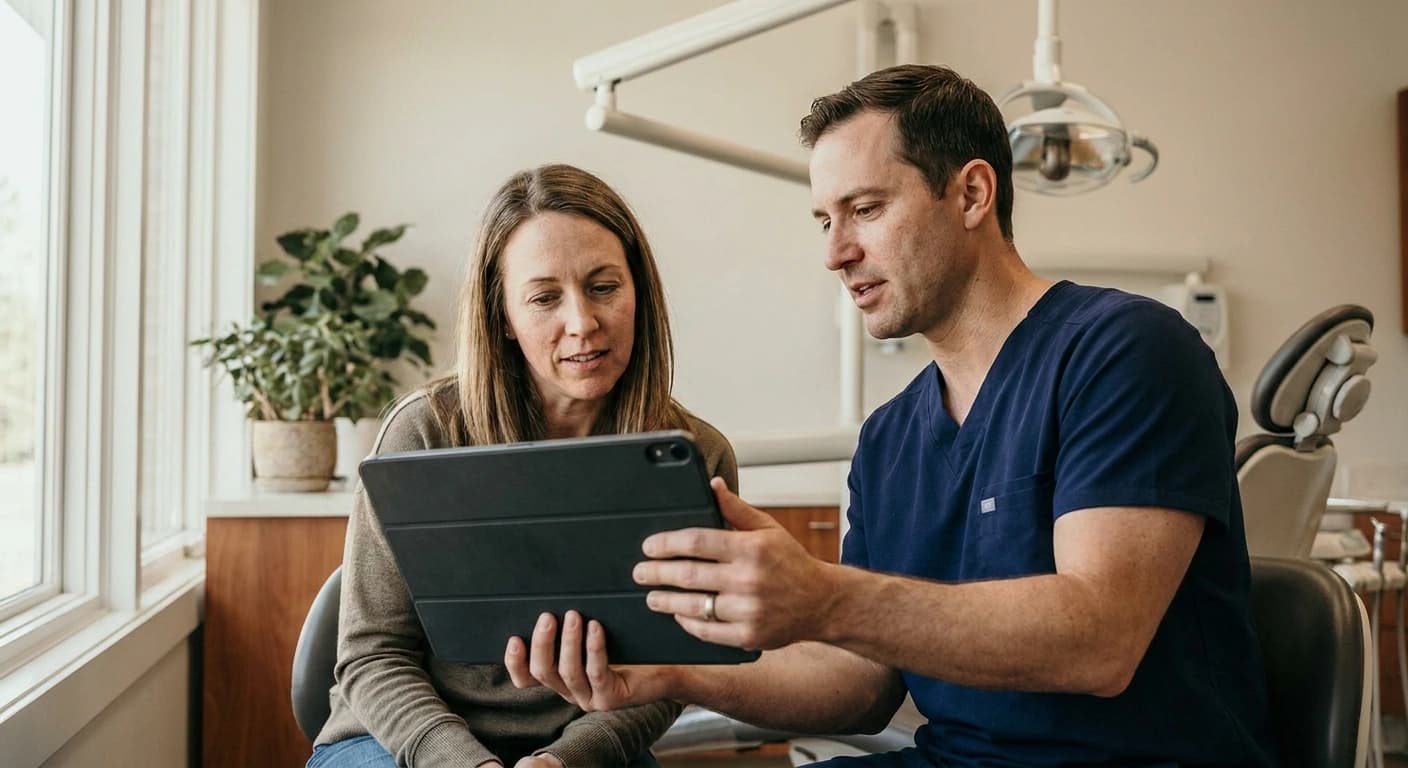
Does smile simulation increase case acceptance?
Vendors say yes, with numbers that range from 38% more cases to triple, but no controlled trial has measured a lift yet. The research that does exist says a preview reliably changes how patients see their own smile, and that it moves the decision when a dentist guides the conversation, not when a patient looks at a simulation alone. In one 2026 study, slightly fewer people wanted treatment after previewing their smile without clinical guidance.
That is a more useful answer than another lift claim. It tells you where the value of a preview comes from, and it tells you how to use one so it helps the patient instead of confusing them. If you are working on dental case acceptance across your whole consult, this is the piece that sits at the moment the patient sees the result.
What do smile simulation vendors claim?
Start with what is on the vendors' own pages. We fetched both of these homepages on October 16, 2026, and quote them as written.
| Vendor | Claim as written on the homepage | What the page cites |
|---|---|---|
| SmileViz (smileviz.com, fetched 2026-10-16) | "Practices using it close 38% more cosmetic cases" and "3X case acceptance" | The 38% figure is tied on the same page to one practice's results over one quarter; no study design or sample is shown for 3X |
| SmileSIM (smilesimdmd.com, fetched 2026-10-16) | "SmileSIM customers have doubled their case acceptance!" | No study design or sample size is shown |
Two things stand out. First, the claims do not agree with each other: 38% more, double, and triple are very different outcomes. Second, none of them comes with a method you could check, such as how many practices, which procedures, compared against what, or over how long.
That does not make the claims false. A practice that started showing every cosmetic patient their own result and saw more yeses is a real story. But a single practice's quarter is an anecdote, not a benchmark, and it is fair to read it that way before you build a budget around it.
What does the research actually show?
The most direct study we found was published on January 2, 2026, in the International Journal of Dentistry. Mourgues and colleagues at Rey Juan Carlos University in Madrid followed 51 people who had a smile photo taken, then viewed an AI simulation of their smile after orthodontic treatment.
Here is what they found:
- Perception improved. Participants rated their smile higher after seeing the simulation, moving from an average of 5.84 to 7.00 on a 10-point scale, with the clearest gains in alignment, color, and shape.
- Willingness to treat did not go up. The share of participants who intended to pursue orthodontic treatment went from 49.0% to 45.0%.
- Both directions happened at once. The simulation persuaded 30.7% of the people who were hesitant at the start, but 40.0% of those who began in favor of treatment changed their minds after seeing the result.
The authors' conclusion is the line worth remembering: "SV improves smile perception but has limited influence on treatment motivation without clinical guidance."
Be precise about the scope. This was 51 orthodontic patients using a self-serve simulator, rating themselves, with no control group. It was not a veneer consult with a dentist in the room. The authors say so directly: the simulator "was used outside the context of a formal orthodontic consultation," so participants saw a raw image with no professional explanation.
The other source vendors and blogs lean on is a 2022 review of Digital Smile Design in the Journal of Pharmacy and Bioallied Sciences. It states that previsualization "drastically increases the patient's acceptance rate", but it reports no measured rate. It is an expert view from a review article, not a trial result.
So the honest summary is this. The evidence base is small. It supports the idea that a preview changes how patients see themselves. It does not yet support a specific lift number, and it hints that the setting around the preview matters more than the preview itself.
Why would a preview make some patients less likely to say yes?
Because a picture sets an expectation, and an expectation without context can cut either way.
When a patient sees a simulated smile on their own, a few things can happen:
- The gap looks too big. The patient sees how far their current smile is from the preview and decides it must mean a long, expensive, uncertain process. Without someone explaining what it actually takes, the size of the change reads as risk.
- The patient decides they look fine. A preview can also show a change that feels smaller than the patient imagined. If the difference does not seem worth it, they leave satisfied with what they have.
- The details raise new questions. The Mourgues study found that patients with a negative reaction were driven mainly by tooth shape. A patient who dislikes one detail of the preview, and has no one to say "that part is adjustable," may reject the whole idea.
None of those is a failure of the image. They are failures of the conversation around it. The authors make the same point when they discuss expectations: a simulation can create unrealistic hopes about color or shape that the planned treatment would not deliver on its own. The fix is a clinician explaining what is realistic, early.
This is where the patient psychology of a cosmetic consult does most of its work. The preview gets the patient's attention. The dentist turns it into a plan they trust.
When does a smile preview help a patient decide?
The research and the vendor stories point to the same setting, even if they never say it outright. A preview helps when it is part of a guided consult, not a standalone novelty. At the concept level, that means four things:
- It is the patient's own face. Before and after photos of other patients always leave room for "that's their smile, not mine." We covered the psychology in why patients say yes when they can see the result.
- The dentist is in the room. The clinician explains what the preview shows, what is realistic, and what the treatment involves. That context is exactly what the 2026 study's participants did not have.
- It happens in the same visit as the price. A preview that goes home without a number turns into "I'll think about it." A preview shown alongside the fee and the ways to pay keeps the decision in the chair.
- The image is trustworthy. A preview that looks fake undermines everything after it. Our guide on how accurate AI smile simulations are explains what to look for.
Smile PreVue is built for that moment, as the sales tool for the cosmetic consult rather than a design tool for later. It turns one photo into a photorealistic veneer or whitening preview in about 20 to 30 seconds, with 20+ VITA shades, on an iPad in the operatory or in a desktop browser. The practice can send the preview home by email, or by text with the patient's double opt-in, and as a branded PDF report.
When the patient is ready to move forward, they can pay in full or apply to pay over time through Affirm, Klarna, or Sunbit, subject to approval. Smile PreVue is not the lender. Every preview also gets a Fidelity Score that only the clinical team sees. It checks the image against the patient's own photo and the requested treatment. It is never a clinical prediction of how the finished restoration will look. Patient photos are processed in a HIPAA-compliant way under the Google Cloud BAA on Vertex AI.
What we do not do is publish a case acceptance lift for Smile PreVue. We have not measured one across practices, so we do not claim one.
How should a practice measure whether simulation is working?
If no one has a trustworthy benchmark, the best number is your own. You do not need a research team to get one, just a clean before and after.
- Pick a baseline window. Pull your cosmetic consults from the last few months before you started showing previews, and record how many accepted.
- Separate by procedure. Veneer, whitening, and combination cases close at different rates. Mixing them hides what is actually changing.
- Track same-visit yes separately from eventual yes. A preview should move decisions into the chair. If eventual acceptance holds steady but same-visit acceptance rises, the tool is shortening your sales cycle, which is worth money on its own.
- Keep the comparison honest. If you changed your fee, your financing options, or your team at the same time, note it. Otherwise you will credit or blame the wrong thing.
Then do the cost math. Our breakdown of the cost math of smile simulation walks through how few extra cases it takes to cover a subscription. For reference, Smile PreVue pricing is one plan: $149.00 per provider per month on the web ($1,199 per year), or $149.99 per month in the App Store.
FAQ
Is there a study proving smile simulation raises case acceptance?
Not yet. The published evidence is small, and the most direct recent study (51 orthodontic patients, 2026) found that perception improved while willingness to treat dipped slightly when patients previewed alone. Vendor lift figures come from their own customers and do not show a study design.
Can showing a smile simulation backfire?
It can when the patient sees it without guidance. In the 2026 Mourgues study, 40.0% of participants who started out in favor of treatment changed their minds after viewing the simulation alone. A dentist explaining what is realistic is the difference.
Does Smile PreVue publish a case acceptance lift?
No. We have not measured a lift across practices, so we do not claim one. We suggest every practice measure its own same-visit acceptance before and after.
How long does a Smile PreVue preview take?
About 20 to 30 seconds from one photo, chairside on an iPad or in a desktop browser. Smile PreVue previews veneers and whitening.
See it in your own consult
The research points to the chair, not the screen, as where a preview earns its keep. To try it with your own patients, start a 3-day free trial on the web with no card required, or download the iOS app, whichever fits how your team works.
More from the Blog
Digital Smile Analysis vs Smile Simulation: What Differs
What is digital smile analysis, and how is it different from a smile simulation? A plain guide for dentists on what each does before a cosmetic consult.
Case AcceptanceReducing Dental Treatment Hesitation: What 233 Studies Say
Reducing dental treatment hesitation starts with what patients weigh. A 233-study review ranks cost, fear, aesthetics and pain. Here is what to do with it.
Case AcceptanceWhy Patients Say Yes When They Can See Their Smile
Patients decline cosmetic dentistry because they can't picture the result. Smile simulation changes that. Learn how visual previews boost case acceptance rates.