Smile Mockup Software for Dentists: Digital vs Wax-Up
Smile mockup software for dentists shows the finished result chairside in under 30 seconds. Here is how a digital mockup compares to a diagnostic wax-up.
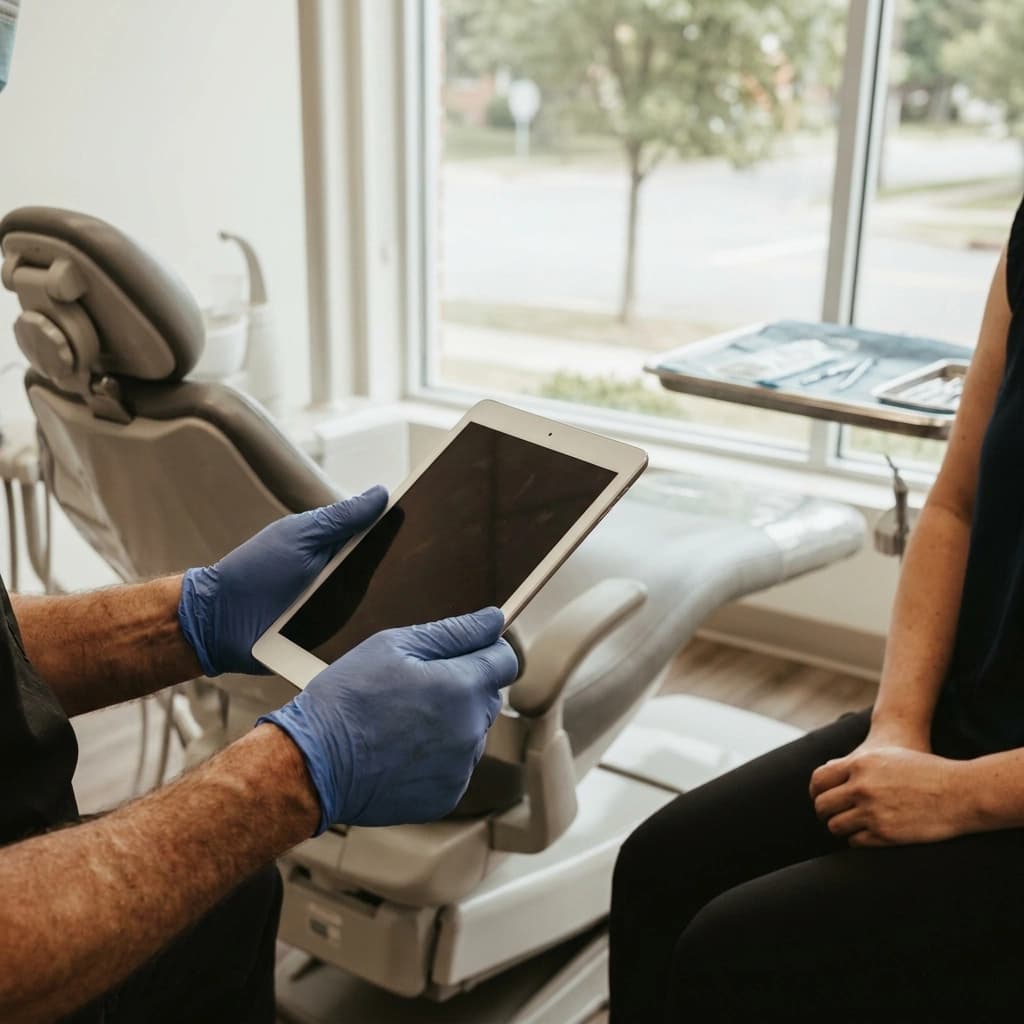
Smile mockup software for dentists shows a patient a realistic preview of their own smile after treatment, on their own photo, during the consult. There is no impression, no lab fee, and no second appointment. Smile PreVue produces that preview in under 30 seconds on an iPad, with no extra hardware.
In dentistry the word "mockup" already means something. It means a diagnostic wax-up on a model, or a direct composite mock-up in the mouth. Both are real clinical tools and neither is going anywhere. A digital mockup is not competing with them. It answers a different question, for a different person, at a different moment.
What is smile mockup software for dentists?
It is a patient communication tool. The clinician photographs the patient, specifies the treatment being proposed and the target shade, and the software renders that specific plan onto the patient's face for them to look at while they are still in the chair.
Smile PreVue supports 20+ VITA shades, runs on an iPad the practice already owns, and takes about ten minutes to set up. It is HIPAA compliant and BAA covered.
Draw the line early, because it matters for the rest of this post. A mockup is a visualization of a proposal the dentist has already made. It is not a diagnosis and it is not a treatment recommendation. The clinician owns the plan, the prep, and the shade. The software only shows the patient what the plan looks like.
How is a digital mockup different from a diagnostic wax-up?
The wax-up is for the clinician and the lab. It plans the restoration in three dimensions, tests the occlusion, and becomes the reference for the provisional. It is the gold standard for planning, and this post is not arguing otherwise.
But look at what the wax-up costs to produce. It needs impressions or a scan, lab turnaround time, a lab fee, and usually a second appointment. By the time it exists, the patient has already gone home. The same timing question applies to outsourced design work, which we compare in dental simulation service vs chairside software.
That is the gap. The patient made their decision, or failed to make it, in the operatory on the day of the consult. The wax-up arrives after the moment it could have influenced.
A digital mockup lands inside that moment. It is not a better wax-up. It is an answer to the only question the patient is actually asking, which is what this is going to look like on my face.
Most practices end up doing both. The mockup gets the yes, then the wax-up plans the case properly. They are sequential, not competing.
Digital mockup vs wax-up vs composite mock-up: how do they compare?
| Digital smile mockup | Diagnostic wax-up | Direct composite mock-up | |
|---|---|---|---|
| When the patient sees it | During the consult | At a later appointment | During a dedicated appointment |
| Turnaround | Under 30 seconds | Days to weeks, lab dependent | Same visit, chair time required |
| Added lab cost | None | Lab fee per case | Material cost, no lab fee |
| What question it answers | What will this look like on me | How will the restoration be built | How will this feel and look in my mouth |
| Chair time required | Minimal | None at the consult | Significant |
| Effect on same-visit decisions | Direct, patient decides while looking at it | None, patient has already left | Direct, but costs a dedicated appointment |
| Clinical planning value | None, it is a visualization | High, it is the planning tool | High, tests function and esthetics intraorally |
Read the last row carefully. A digital mockup contributes nothing to clinical planning and should never be presented as if it does. That is the honest limitation, and stating it plainly is what makes the rest of the comparison trustworthy.
Why does seeing the result change whether a case gets accepted?
Patients are rarely rejecting the dentistry. They are declining to buy an outcome they cannot picture.
On a five figure elective purchase, uncertainty reads as risk. And risk does not get refused outright, it gets deferred. "Let me think about it" is what deferral sounds like.
Description does not close that gap. A dentist can describe the proposed result accurately and well, and the patient still has to build the image themselves, out of a vocabulary they do not have. Two people leave that conversation imagining two different smiles.
A binder of someone else's before-and-after photos does not close it either. The patient can see that the work is good. They cannot see that it will be good on them.
Showing the patient their own face after treatment removes the guessing. The decision stops being about trust in a description and starts being about whether they like what they are looking at. That is a much easier decision to make in the room. This is the mechanism behind most of what actually moves case acceptance.
What this post will not do is hand over a consultation script. The framing matters more than the wording, and the framing is what we just described.
Does the practice economy make the case for a chairside mockup?
The numbers this year point in an uncomfortable direction. The ADA Health Policy Institute's Q2 2026 dental economy update reports that consumer spending on dental care is up only 1% over the last 12 months, while dentists in Q2 2026 reported being busier with longer appointment wait times.
Busier chairs, flat spending. HPI's own read is that dentists may be working harder for the same revenue.
Underneath that sits what HPI calls the fiscal squeeze. Over the past five years, prices for dental equipment and supplies plus wages of dental staff have gone up 23%, while reimbursement averaged across all payor types has gone up 19%. The gap comes straight out of the bottom line.
The operator conclusion is uncomfortable but clear. If the chairs are already full and each unit of work is worth slightly less than it used to be, growth does not come from adding volume. It comes from converting more of the high-value consults already on the schedule.
That is the entire economic argument for a chairside mockup. Not that it creates new demand, but that it improves the yield on demand you have already paid to acquire. We are not going to attach an invented ROI percentage to that, because we do not have one worth publishing.
Where does AI belong in a cosmetic consult, and where does it not?
The same ADA report includes new data on how dentists actually feel about AI, and the split is sharp. 43% of dentists now use AI for at least one task in the practice, most commonly imaging and diagnostics. But four out of five say they have no interest in using AI for patient treatment recommendations, stressing clinical judgment and human verification. Those figures come from 552 private practice respondents, fielded in June 2026.
That is the correct instinct, and a mockup sits on the safe side of it. Notably, 13.2% of dentists already use AI for explaining clinical findings to patients, which is the patient-communication category a mockup belongs to, not the clinical decision category.
We wrote about that boundary in more depth in AI smile simulation vs AI diagnosis. The short version is that the clinician still owns diagnosis, plan, and shade. The software renders. It does not decide.
The second question a practice owner asks is about the patient photos, and it should be. Smile PreVue is HIPAA compliant, we sign a BAA with each practice before any patient data flows, and our subprocessors are covered under BAAs with us.
Where does Smile PreVue fit against DSD?
Digital Smile Design is a genuine methodology with real depth. It is a full planning discipline, with training behind it, and practices that have invested in it get a lot out of it.
It also asks for that investment. Training, workflow change, and time per case are all part of the deal. If you are unsure where the clinical side ends and the patient preview begins, we broke down digital smile analysis vs smile simulation separately.
Smile PreVue is aimed at a narrower job. It is the fast chairside answer to the patient's question, not a replacement for a planning methodology. A practice can run DSD for its complex cases and still want something that takes under 30 seconds during a consult. The same split applies to design platforms like Smilecloud, and we laid out Smilecloud pricing and what each tool includes from the vendor's own pages.
Smile mockup software FAQ
Do I still need a diagnostic wax-up if I use a digital mockup? Yes, for anything you would have waxed up before. The mockup is a patient decision tool, not a planning tool. Most practices run the mockup at the consult and the wax-up after the case is accepted.
Does it need an intraoral scanner or special hardware? No. Smile PreVue runs on an iPad with no additional hardware, and setup takes about ten minutes.
Is patient photo data HIPAA compliant? Yes. Smile PreVue is HIPAA compliant and we sign a BAA with each practice before any patient information flows through the system.
How long does one mockup take? Under 30 seconds, during the consult, with 20+ VITA shades available.
Can I try it before committing? Yes. There is a 3-day free trial through the App Store, so you can run it on real consults before deciding.
If the chairs are already full and the margin is getting thinner, the next case is more likely to come from the consult you already have than from a new patient you have not met yet. Start the 3-day free trial and run it on your next cosmetic consult.
More from the Blog
Smile Simulation on an iPad: Do You Need a Scanner?
Smile simulation on an iPad needs no scanner and no lab wax-up. What a photo-based preview does chairside, how it compares to DSD and TRIOS, and why it matters.
Practice TechnologyVirtual Smile Design vs AI Smile Simulation: Which One Closes More Cases?
Virtual smile design changed cosmetic dentistry. AI smile simulation is changing it again. Here's how the two compare for case acceptance, speed, and ROI.
Case AcceptanceWhy Patients Say Yes When They Can See Their Smile
Patients decline cosmetic dentistry because they can't picture the result. Smile simulation changes that. Learn how visual previews boost case acceptance rates.