Dentist AI Adoption Statistics 2026: The Chairside Gap
Dentist AI adoption statistics for 2026: 43.3 percent of dentists use AI in the practice, but only 13.2 percent use it with patients. Why the gap matters.
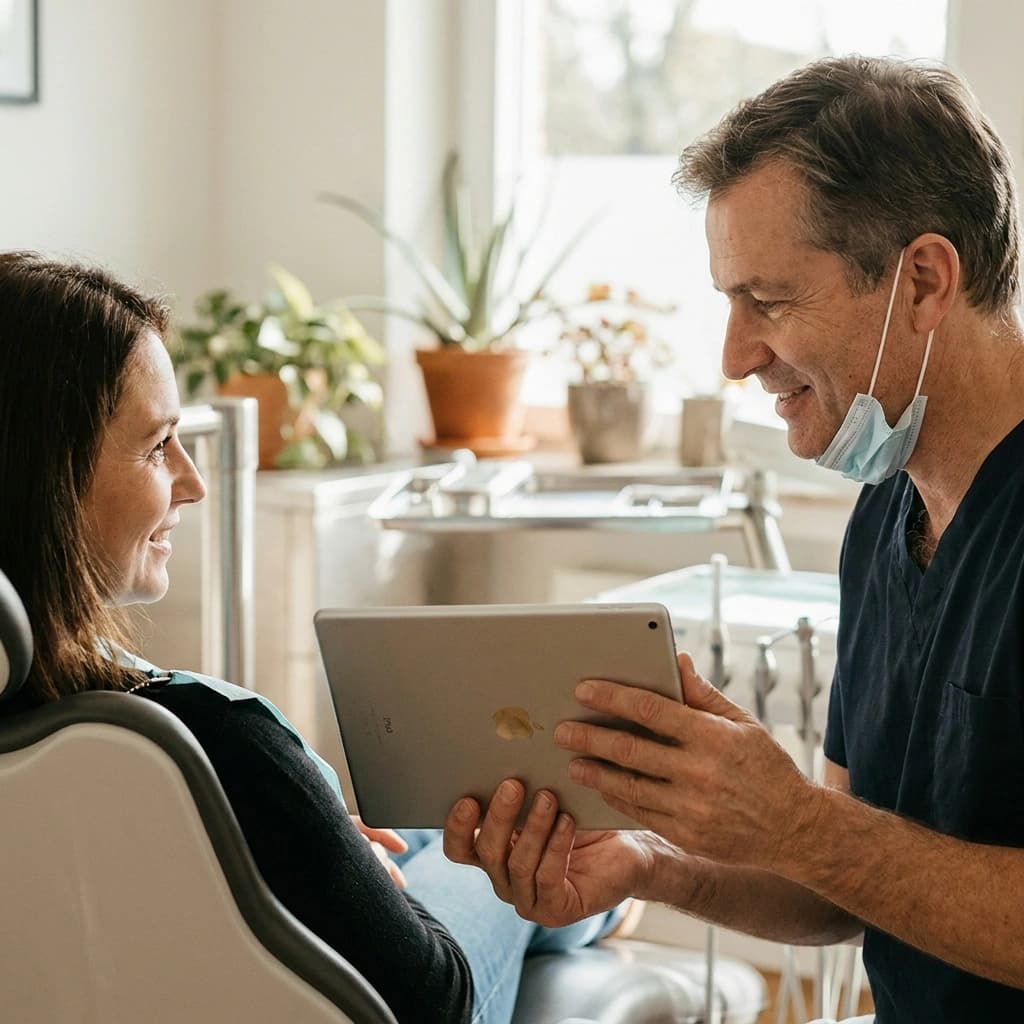
About 43 percent of dentists now use AI for at least one task in the practice, according to the American Dental Association Health Policy Institute's Q2 2026 survey. Only 13.2 percent use it for anything the patient actually sees. Dentistry has adopted AI almost everywhere except the room where a patient decides yes or no on a five-figure cosmetic plan.
That is the chairside gap, and it is not an oversight. It is a trust boundary, and it tells you exactly what a patient-facing tool has to prove before a dentist will put it in front of a chair.
How many dentists actually use AI in 2026?
The ADA Health Policy Institute added a section on AI usage and attitudes to its Q2 2026 State of the U.S. Dental Economy report. It is the first broad, current read on where AI actually sits inside a practice.
The headline split, from that Q2 2026 survey:
- 43.3 percent currently use AI for at least one task in the practice
- 26.4 percent do not use it but plan to
- 30.3 percent do not use it and do not plan to
So AI is already normal in roughly two out of five dental offices, and another quarter are on deck. This is no longer an early-adopter story. What matters now is not whether dentists use AI, but where they let it sit.
Where inside a dental practice is AI actually being used?
The ADA asked task by task. Ranked by current use in Q2 2026:
- Imaging and diagnostics: 22.8 percent currently use, another 25.4 percent plan to
- Insurance verification: 13.6 percent
- Explaining clinical findings to patients: 13.2 percent
- Social media: 10.7 percent
- Practice analytics and business intelligence: 10.1 percent
- Receptionist and front-desk check-in tools: 10.1 percent
- Billing and claims submission: 9.2 percent
- Appointment scheduling: 9.2 percent
- Charting and note taking: 7.4 percent
Look at what the top of that list has in common. Imaging output gets read by a clinician before it leaves the operatory. An insurance verification gets checked by a biller. A claim gets reviewed before submission. Charting gets signed. In every high-adoption case, a human sits between the AI and anyone outside the practice.
The next wave is more of the same. Among dentists who plan to start using AI, the nearest-term intentions for 2026 are front-desk check-in tools at 32.4 percent and appointment scheduling at 29.6 percent, followed by practice analytics and charting. Administrative, internal, reversible.
Dentistry did not adopt AI by capability. It adopted AI by risk.
Why is patient-facing AI the last thing dentists adopted?
The two lowest-acceptance uses in the whole ADA list both touch the patient conversation.
Treatment recommendations is the floor: 82.6 percent of dentists say they do not use AI for it and do not plan to. The ADA's own takeaway is blunt, that four out of five dentists have no interest in AI making treatment recommendations. Explaining clinical findings to patients is not far behind, with 68.3 percent saying they do not use it and do not plan to.
The sentiment data explains why. Asked how they feel about expanded AI use in dentistry, the top two responses were general optimism about the potential at 21.5 percent, and the view that AI is a tool that should not replace clinical judgement at 17.7 percent. In the written comments, dentists returned to accuracy and to human verification.
That is a coherent position, not a technophobic one. The moment something is shown to a patient, it stops being a draft. It becomes a promise the practice has to stand behind, in a conversation the practice does not fully control, about a treatment that has not happened yet.
So the useful line is not AI versus no AI. It is between a tool that decides and a tool that shows. We covered that distinction in depth in AI smile simulation vs AI diagnosis, and the ADA data is the strongest evidence yet that dentists already draw the same line instinctively.
What does patient-facing AI look like when it is done right?
A cosmetic outcome simulation is a communication tool. It shows a patient a photorealistic preview of how their own smile could look. It does not read a radiograph, it does not name a pathology, and it does not recommend a course of treatment. The dentist still owns every clinical call, exactly as the 82.6 percent would insist.
Smile PreVue sits in that lane on purpose. It produces a simulation of the cosmetic result in under 30 seconds, on an iPad in the operatory, with no scanner and no extra hardware, across 5 treatment types and 20 or more VITA shades. The patient sees themselves, and the conversation stops being hypothetical.
Here is how that compares to the two things most practices use today:
| Smile PreVue | Digital Smile Design | Stock before-and-after photos | |
|---|---|---|---|
| Time to result | Under 30 seconds | Days, across planning and lab time | Immediate |
| Hardware needed | None beyond an iPad | Scanner, camera setup, and software workflow | None |
| Where it happens | In the consult, chairside | Between visits, with the lab and the clinical team | In the consult |
| What the patient sees | Their own face with the proposed result | A designed plan, usually presented at a later visit | Someone else's teeth |
Digital Smile Design is the established protocol and it earns its place. It is a full planning system with training, workflow, and lab time attached, and it produces clinical planning value that a chairside preview does not. The two are not substitutes. The gap DSD does not fill is the live consult, the ten minutes where a patient is sitting in the chair deciding, and stock photos of somebody else's veneers are still the default answer in that moment.
What should a practice check before putting AI in front of a patient?
Two questions cover most of the risk.
Where does the patient photo go? A patient photo is protected health information. Ask whether the vendor will sign a business associate agreement, which subprocessors touch the image, and where the processing happens. Smile PreVue is HIPAA-compliant and BAA-covered, running on Google Vertex AI under a signed BAA, with in-app consent capture and audit logging. We go through the full vendor due-diligence checklist in what a BAA with an AI vendor actually covers, so we will not re-argue it here.
What does the tool claim? This is the scope question, and it is the one the ADA data is really about. A tool that visualizes a cosmetic outcome keeps the practice inside the boundary dentists have already drawn. A tool that offers a diagnosis or a treatment recommendation crosses it, and 82.6 percent of your peers have already said no to that.
Why the chairside gap is a case acceptance problem
Put the two halves together and the picture is strange. A practice may have AI reading the radiograph before the dentist walks in the room. Twenty minutes later, that same practice explains a 20,000 dollar cosmetic plan with words, a hand mirror, and a photo of a stranger.
The economics of that moment are not subtle. According to the 2026 Catalyst Index, reported by Henry Schein One in June 2026, the average practice accepts about 45 percent of presented treatment plans, while the top 10 percent of practices accept 75 percent. The difference between an average practice and a top-decile one is not diagnosis, and it is not demand. It is what happens in the presentation.
The takeaway for an operator is simple. AI adoption in dentistry has mapped almost perfectly to risk, and visualization is the one patient-facing use where the practice keeps full control of the claim. Nothing clinical is being asserted. The patient is just seeing the outcome the dentist is already proposing, before deciding whether to buy it. That is why it belongs in any serious conversation about case acceptance.
The back office got its efficiency. The consult is still waiting.
FAQ
How many dentists use AI in 2026? 43.3 percent of dentists currently use AI for at least one task in the practice, per the ADA Health Policy Institute's Q2 2026 survey. Another 26.4 percent plan to, and 30.3 percent do not intend to.
What do dentists use AI for most? Imaging and diagnostics, at 22.8 percent current use. Insurance verification, charting and note taking, billing and claims, and practice analytics follow.
Do dentists use AI to talk to patients? Rarely. Only 13.2 percent use AI to help explain clinical findings to patients, and 68.3 percent say they do not and will not. For treatment recommendations, 82.6 percent rule it out entirely.
Is AI smile simulation the same as AI diagnosis? No. A cosmetic simulation shows a patient a preview of a proposed aesthetic result. It makes no clinical finding and no treatment recommendation. Smile PreVue is a communication and closing tool, not a diagnostic device.
Is AI smile simulation HIPAA compliant? It depends entirely on the vendor. Patient photos are PHI, so the vendor must sign a BAA and cover its subprocessors. Smile PreVue is HIPAA-compliant and BAA-covered, and runs image generation on Google Vertex AI.
If your practice has already put AI behind the front desk, the consult is the obvious next move, and it is the one that pays for itself fastest. Start a 3-day free trial of Smile PreVue and show the next cosmetic patient their own smile before you talk about price.
More from the Blog
Why AI Smile Previews Look Fake, and How to Catch It
Why AI smile previews look fake: the image changes more than the teeth. See what goes wrong and how Smile PreVue checks every preview before the close.
Smile SimulationIs AI Smile Design Actually Accurate? What a 2026 Study Found (and Why It Decides the Case)
A 2026 study put AI smile design head to head with conventional methods. Here is what it found about accuracy, and why it matters for case acceptance.
ProductSmile Simulation on an iPad: Do You Need a Scanner?
Smile simulation on an iPad needs no scanner and no lab wax-up. What a photo-based preview does chairside, how it compares to DSD and TRIOS, and why it matters.