Why AI Smile Previews Look Fake, and How to Catch It
Why AI smile previews look fake: the image changes more than the teeth. See what goes wrong and how Smile PreVue checks every preview before the close.
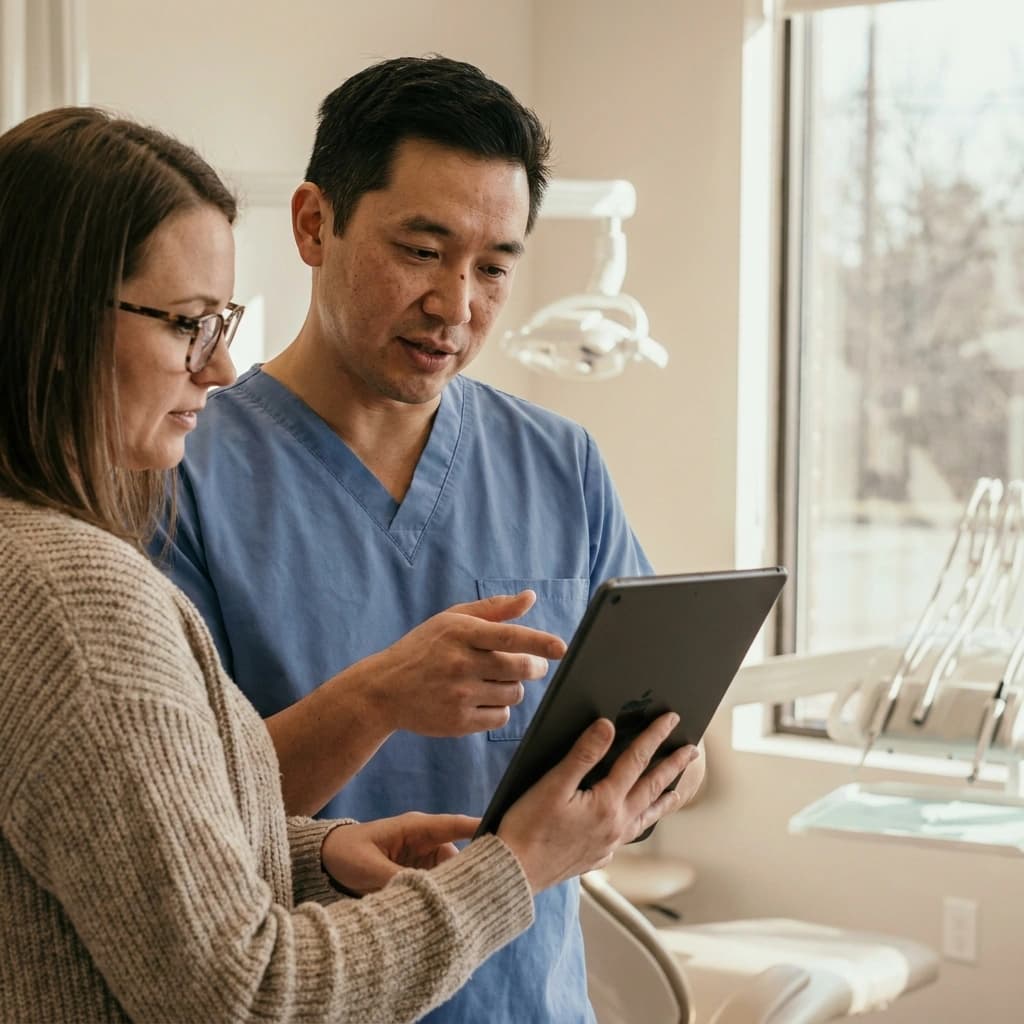
AI smile previews look fake when the image tool changes more than the teeth. The lips shift, the skin smooths, the face narrows, the crop moves, or a shade nobody asked for appears, and the patient senses that the person on the screen is not quite them. A believable preview edits only the teeth, to the treatment that was actually requested, on the patient's own photo. Smile PreVue checks every preview for exactly that with its Fidelity Score, seven checks graded before the clinical team presents the image.
The uncomfortable part is that "fake" rarely means "ugly." Recent research shows AI smiles are usually rated as more attractive than real results. That is the problem, not the reassurance.
What did the 2026 studies find about AI smile images?
Two peer-reviewed studies published this year point in the same direction.
In a Scientific Reports study published in March 2026, Tirkkonen and colleagues showed 288 people (76 dentists, 63 dental students, and 149 laypeople) a mix of real orthodontic outcomes and AI-generated smiles. Sensitivity for spotting the AI images was below 50% in every group. Dentists caught them only 39.1% of the time. On attractiveness, the AI smiles scored 78.8 out of 100 against 37.9 for the real treatment outcomes.
The AI images in that study came from a general-purpose chatbot (ChatGPT running GPT-4o) with a one-line prompt: "Make a realistic perfect smile." No dental rules, no treatment plan, no limits on what could change.
In a Clinical Oral Investigations study published in July 2026, Gasparello and colleagues surveyed 252 people. 63.2% of them misclassified AI-enhanced post-treatment images as real. The AI-enhanced images averaged 69.2 on a visual analog scale versus 53.9 for real results. People who trusted AI content more were more likely to be fooled (odds ratio 1.38).
Both papers looked at orthodontic outcome images, not veneers. The lesson still carries over to any cosmetic consult. The authors of the July study put it plainly in their clinical relevance statement: AI simulations can set unrealistic patient expectations, and clinicians should be open about the limitations when they talk about outcomes.
Here is the read for a practice. The danger is not an ugly image. It is an unconstrained one. A tool with no rules will happily produce a smile no dentist can deliver, on a face that is subtly not the patient's, and it will look great doing it.
What actually goes wrong in an AI smile preview?
When a preview feels off, it is almost always one of a handful of failures. None of them are about the teeth looking bad.
- Identity drift. The face itself changes. Eyes, jawline, or skin texture shift enough that the patient is looking at a cousin, not themselves.
- Framing changes. The crop, zoom, or head angle moves, so the before and after no longer line up and the comparison stops working.
- Reshaped lips. Lips get fuller, thinner, or repositioned. The patient came in about their teeth and leaves wondering why their mouth looks different.
- Edits outside the teeth. Gums, skin, or background get touched when only the teeth should have changed.
- The wrong treatment. The plan was whitening and the image shows a full veneer smile, or the plan was six units and the preview reshaped ten.
- A shade nobody asked for. The result is brighter or cooler than the shade the clinician selected.
- The rendered look. Teeth that read as plastic, too uniform, or too bright under the room's actual lighting.
Every one of these costs the close for the same reason. When a patient looks at a preview, the first question in their head is not "is that a nice smile?" It is "is that still me?" That is the core of the patient psychology of cosmetic dentistry: people buy the version of themselves they can recognize. The moment the patient sees themselves is powerful. The moment they notice it is not quite them, the preview flips from a reason to say yes into a reason to doubt the whole conversation.
It also puts the dentist in a bad spot. A preview that quietly changed the lips or showed the wrong treatment is a promise the clinician never made. On a $25,000 case, that gap becomes a trust problem the day the temporaries go in.
How does Smile PreVue check a preview before the patient sees it?
This is the job of the Fidelity Score, which is on for every Smile PreVue clinic as of September 15, 2026.
After a preview is generated, a second AI model compares it against the patient's original photo and the exact instructions used to create it. It grades the image on seven weighted checks:
- Identity preserved
- Framing preserved
- Lips untouched
- Teeth-only edit
- Treatment fidelity
- Shade match
- Realism
Shade match is skipped on whitening and alignment cases, where no shade is specified. The result shows on the patient record as Excellent, Good, or Review.
A few specifics matter here.
- It does not slow the consult. Grading runs in the background after the preview is already on screen.
- A Review names the problem. When something is off, the record says what, for example that the lips changed. The team can choose "Regenerate with fix," which writes that correction into the instructions, or "Regenerate as is."
- Nothing gets thrown away. Earlier attempts are archived on the patient record under "Previous attempts," each with its own score.
- Only the clinical team sees it. The score is visible to the clinic's signed-in team. It never appears on a share link, a PDF report, or the patient payment page.
- It runs under the same privacy terms as everything else. Grading runs on Google Cloud Vertex AI under the Google Cloud BAA, and Smile PreVue is HIPAA-compliant.
It is just as important to say what the Fidelity Score is not. It measures how faithfully the image kept the patient's face and framing and showed the requested treatment. It is not a clinical prediction, not a diagnosis, and not a promise about how the finished restoration will look. It is a second AI model, not a human reviewer. The dentist's plan still governs the result.
It is included in the subscription at $149 per provider per month, with no add-on and no extra hardware.
Which approach keeps a smile preview honest?
Most practices choose between three options. The table sticks to process facts, not image quality.
| General-purpose AI image prompt | No preview at all | Smile PreVue | |
|---|---|---|---|
| What limits the edit | Whatever the prompt says, for example "Make a realistic perfect smile" | Nothing to limit, the patient imagines the result | The patient's own photo plus the treatment and shade the clinician selected |
| Is each image checked | No | Not applicable | Yes, seven checks on every preview |
| Who sees the check | No one | Not applicable | The clinic's signed-in team only |
| What happens when something is off | Someone has to notice by eye | Not applicable | Review names the problem, with Regenerate with fix or Regenerate as is |
| Privacy terms for patient photos | Depends on the consumer tool | Not applicable | HIPAA-compliant, under the Google Cloud BAA |
| Hardware needed | A phone or computer | None | None, works on an iPad |
The middle column deserves a word. Plenty of practices still run cosmetic consults on verbal description and stock before-and-after photos. That avoids a fake-looking preview, but it asks the patient to picture a stranger's result on their own face. That is the gap previews exist to close.
How should you set expectations when you show a preview?
Both 2026 studies land on the same recommendation: be open about the limits. That does not weaken the close. It protects it.
At a concept level, three ideas hold up:
- A preview shows a direction, not a guarantee. It is a conversation starter about what the patient wants, and it earns its value by making that conversation concrete.
- The dentist's plan governs the result. Saying so out loud is not hedging. It tells the patient who is accountable for the outcome, which is exactly what someone about to spend five figures wants to hear.
- A preview you can stand behind is easier to present. When the team already knows the image kept the patient's face and showed the planned treatment, they can present it with confidence instead of hoping the patient does not notice a problem.
If you want the deeper background on how accurate AI smile simulations are, including what the Fidelity Score measures and what it does not, the pillar page covers it in full.
FAQ
Do AI veneer previews look real to patients? Often, yes. In a July 2026 Clinical Oral Investigations study, 63.2% of 252 participants took AI-enhanced orthodontic outcome images for real. That is exactly why expectations matter: an image that looks real can still show a result no dentist can deliver.
Does any smile simulation software check its own image quality? Smile PreVue does. Its Fidelity Score grades every preview on seven checks, including identity preserved, lips untouched, and treatment fidelity, and shows the result as Excellent, Good, or Review on the patient record.
Can patients see the Fidelity Score? No. It is visible only to the clinic's signed-in team. It does not appear on share links, PDF reports, or the payment page.
Is the Fidelity Score a prediction of the final result? No. It measures how faithfully the image matches the patient's photo and the requested treatment. It does not diagnose, plan treatment, or predict the finished restoration.
Does it cost extra or need special hardware? No. It is included in the subscription at $149 per provider per month, works on an iPad, and you can try it with a 3-day free trial.
See it on your next consult
The goal of a preview is a same-visit yes the patient still feels good about when the case is finished. That takes an image that changed the teeth and nothing else, and a team that knows it before the patient looks.
Start your 3-day free trial of Smile PreVue and see the Fidelity Score on your own cases.
More from the Blog
Is AI Smile Design Actually Accurate? What a 2026 Study Found (and Why It Decides the Case)
A 2026 study put AI smile design head to head with conventional methods. Here is what it found about accuracy, and why it matters for case acceptance.
ProductDentist AI Adoption Statistics 2026: The Chairside Gap
Dentist AI adoption statistics for 2026: 43.3 percent of dentists use AI in the practice, but only 13.2 percent use it with patients. Why the gap matters.
ProductSmile Simulation on an iPad: Do You Need a Scanner?
Smile simulation on an iPad needs no scanner and no lab wax-up. What a photo-based preview does chairside, how it compares to DSD and TRIOS, and why it matters.