Dental Lab Communication for Smile Cases: What the Lab Needs
Dental lab communication on smile cases: what the lab needs, why the patient's approved look belongs in the handoff, and where a chairside preview fits.
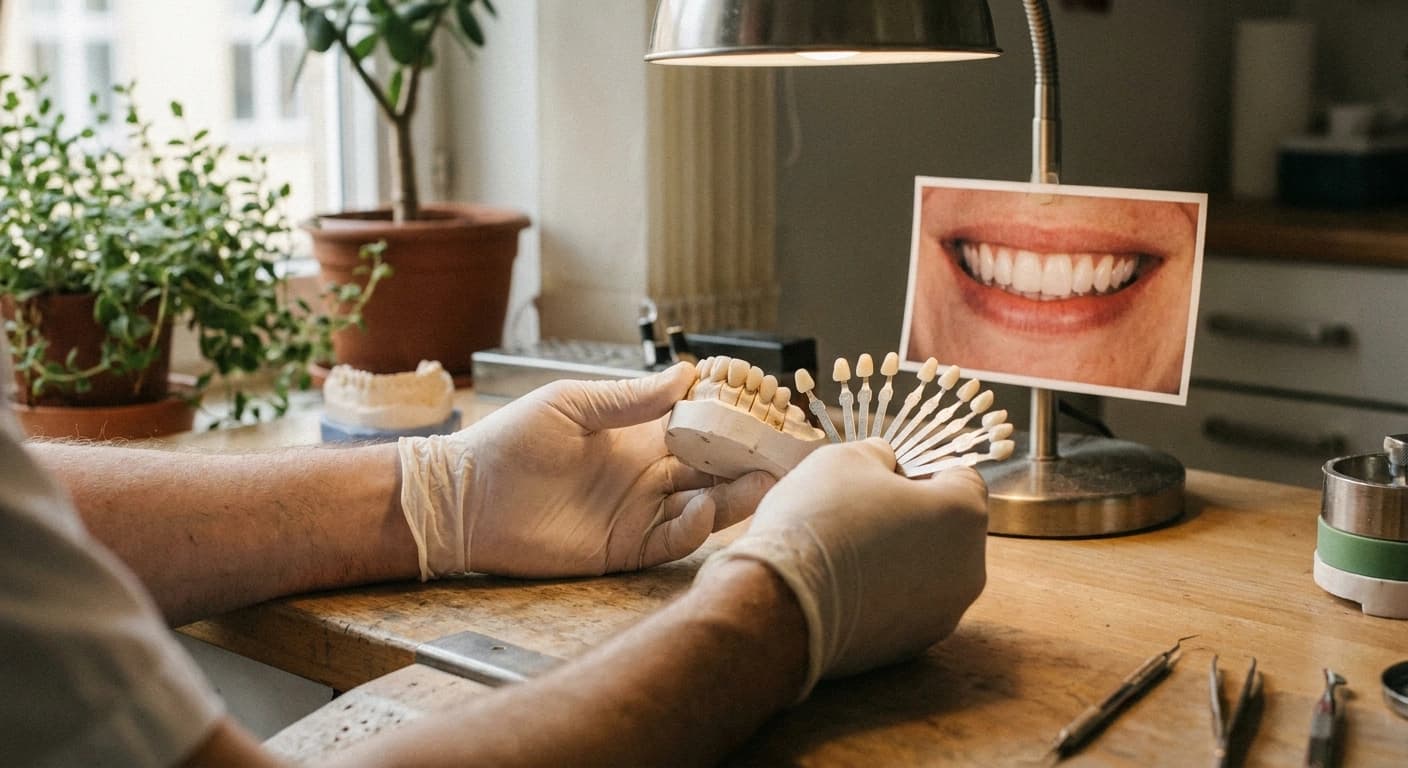
On a cosmetic case, the lab needs good photos, the shade, the clinical records and models, and a clear statement of the look the patient agreed to. The last item is the one most often missing. It is also the one that decides whether the patient is happy on the day the veneers go in.
Most advice on dental lab communication is about records: which photos, which measurements, which form. That advice is right, and labs are clear about it. This post is about the piece that sits upstream of the records. If the patient never really agreed to a direction, or the lab builds toward a different picture than the one the patient agreed to, no prescription form fixes it.
What does a dental lab need from the clinic on a smile case?
Think of it as four things, in order of how often they cause trouble.
- Photos. A full-face smile, a relaxed face, the arches, and close views of the front teeth. A 2022 review of digital smile design (Thomas and colleagues, Journal of Pharmacy and Bioallied Sciences, read on PubMed Central on October 14, 2026) notes that a 1:1 close view of the central incisor against a black background gives the lab technician the detail they need to work from.
- Shade. Recorded the way your lab reads it, under light your lab expects, so the number on the slip means the same thing on both ends.
- Clinical records. Impressions or scans, bite records, and whatever measurements your planning process produces.
- The agreed direction. What the patient said yes to: how bright, how long, how natural or how bold. This is the part that usually travels as a sentence on a form, or not at all.
The first three are craft, and most practices and labs have them worked out. The fourth is a communication problem, and it starts before the lab is involved at all.
Why does lab communication break down on cosmetic cases?
A cosmetic case has three parties, and each one is holding a different picture.
The dentist holds a clinical plan: proportions, gum line, bite, what the teeth can safely support. The patient holds a hope, usually vague and often shaped by photos of other people's smiles. The technician holds whatever they can reconstruct from the records and the notes on the slip. When those three pictures line up, the case goes smoothly. When they do not, the gap shows up at try-in or at seat, which is the most expensive moment to find it.
The same 2022 review makes the point directly. Citing earlier work by Cervino and colleagues, it says digital smile design "drastically improves the communicative link between the patient, the clinician, and the technician in treatment planning." It also names the limit honestly: sometimes the patient disagrees with the outcome of the treatment even though the software had predicted a better one.
That second line is the one worth sitting with. Better tools for the dentist and the lab do not, on their own, guarantee the patient agreed to the same thing. Alignment has to be built on purpose, and it has to include the person who will be looking in the mirror.
Why should the patient's approved look travel with the case?
Because it is the reference everyone else is building toward, and it protects everyone involved.
The review notes that in a digital smile design workflow, the patient's approval of the post-visualization photographs is obtained before treatment begins, and that this gives the clinician comfort on the medico-legal side. That approval is doing two jobs. It confirms the patient chose a direction. It also gives the case a fixed point the dentist can come back to if expectations drift later.
Labs describe the same goal from their side of the bench. Pan-Am Dental Laboratory, writing on its own blog in December 2025 (panamdl.com, read October 14, 2026), says "a successful Digital Smile Design process depends on strong collaboration between the clinician and the dental lab," and describes the aim as a final restoration that "mirrors the approved design."
Notice the word approved. A lab cannot build what nobody approved. If the only record of the patient's wishes is "wants them whiter and more even," the technician is guessing, and a guess that misses becomes a remake, an awkward conversation, or both.
There is a sales side to this too, which is why lab communication belongs in a conversation about case acceptance. A patient who has clearly agreed to a look is a patient who has made a decision. That decision is what gets the case started in the first place, and it is what keeps the case calm all the way to delivery.
Where does a chairside smile preview fit before the lab?
Earlier than most practices think. The order that keeps all three pictures aligned looks like this:
- The patient sees a direction and reacts to it. This is where hope becomes something concrete enough to say yes or no to.
- The dentist does the clinical analysis and takes records. Proportions, function and what is actually achievable. We covered how that step differs from a preview in digital smile analysis vs a smile simulation.
- The lab builds from the records, with the agreed direction attached.
The first step is the one Smile PreVue is built for. It is a patient-facing preview and closing tool. From a single photo, it produces a photorealistic veneer or whitening preview of the patient's own face in about 20 to 30 seconds, chairside on an iPad or in a desktop browser, with 20+ VITA shades to choose from. There is no scanner or other hardware involved, which we explain in smile simulation on an iPad with no scanner.
Once the patient has picked a look, the practice can produce a branded PDF simulation report and keep it with the case, so the direction the patient chose is on paper for the chart and for the conversation with the lab. The practice can also share the simulation with the patient by email, or by text with the patient's double opt-in, so the patient goes home with the same picture the team is working from. Photos are processed in a HIPAA-compliant way under the Google Cloud BAA on Vertex AI.
To be plain about the limits: Smile PreVue is not a lab design tool, not CAD software and not a prescription. It does not measure proportions, it does not send anything to a lab, and it does not connect to lab or practice software. The records, the analysis and the prescription stay exactly where they are in your workflow today. What changes is that the patient's side of the case is settled first, with a picture rather than a description.
If you want the full list, see what Smile PreVue does, and if you are weighing preview tools against each other, our guide to dental case presentation software covers the wider category.
What should a practice agree with its lab before the next veneer case?
You do not need a new form. You need a short conversation with your lab, held once, before the next case rather than during it. A few principles worth settling:
- What photos the lab wants, and how it wants them framed. Ask rather than assume. Labs differ, and the ones that care about esthetics usually have strong opinions.
- How shade is recorded. Agree on the shade system and the lighting so a shade on the slip is not a translation exercise.
- How the patient's approved direction is shown. A reference image of the look the patient chose, a short written description, or both. The point is that the technician sees what the patient agreed to, not only what the dentist measured.
- What happens when the clinical plan and the patient's wish disagree. Sometimes the look a patient loves is not what the teeth can support. That conversation belongs with the patient in the chair, before records go out, not after the work comes back.
None of this is a script. It is the frame that makes the records mean something. Practices that do it tend to find that the lab relationship gets easier, because the technician spends less time guessing and more time doing the work they are good at.
How does better lab communication help case acceptance?
It helps at both ends of the case.
At the start, the step that aligns the lab is the same step that helps the patient decide. A patient who has seen a believable picture of their own smile is answering a simple question, do I want this, rather than being asked to imagine a result and take the price on faith. That is where a same-visit yes comes from.
At the end, a case that was aligned from the start is less likely to produce the patient who sits up at seat and says that is not what they pictured. That moment costs chair time, lab time and goodwill, and it is the kind of story patients repeat. Every practice knows the case it wishes had gone differently. Most of those cases did not fail at the bench. They failed earlier, when three people were holding three different pictures and nobody noticed.
Frequently asked questions
Is a smile simulation a lab prescription?
No. A smile simulation is a preview for the patient. The lab still needs the prescription, the records and the dentist's clinical plan.
Can a lab work from a preview image alone?
No. A preview shows the direction the patient agreed to. The lab still needs photos, shade, models or scans and bite records to build anything that fits.
Does Smile PreVue connect to my dental lab?
No. Smile PreVue has no lab or practice software integrations. It is a patient-facing preview tool. The practice can keep a branded PDF simulation report with the case and decide how to use it in its own lab conversation.
Is the patient's photo handled under HIPAA?
Yes. Patient photos are processed in a HIPAA-compliant way under the Google Cloud BAA on Vertex AI.
Can I try it before my next cosmetic consult?
Yes. You can start a 3-day free trial on the web, with no card and up to 3 simulations a day, or download the app from the App Store, whichever fits how your practice works.
More from the Blog
Digital Smile Analysis vs Smile Simulation: What Differs
What is digital smile analysis, and how is it different from a smile simulation? A plain guide for dentists on what each does before a cosmetic consult.
Case AcceptanceDental Simulation Service vs Chairside AI Software
A dental simulation service returns a designed preview in an hour or days. Chairside software shows it in the visit. How to choose for case acceptance.
Case AcceptanceDental Patient Retention Fell to 64%. Case Acceptance Is Why
Dental patient retention fell from 72% to 64% in 2026. Why case acceptance drives patient retention, and what top practices do differently in the chair.