How to Write Dental Clinical Notes That Hold Up
How to write dental clinical notes that hold up: what the ADA and state boards expect, SOAP structure, late entries, signatures, and where AI drafting fits.
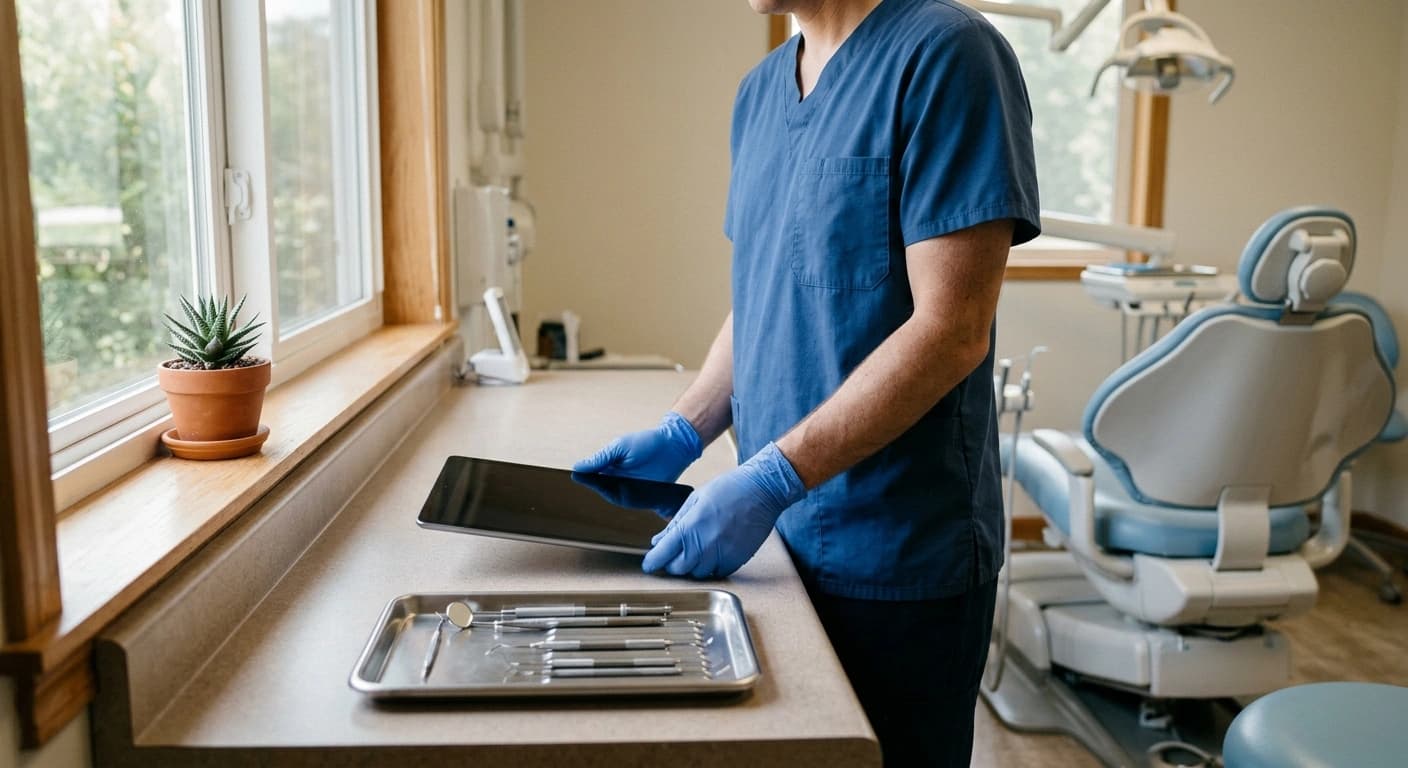
A dental clinical note that holds up records, for every visit, why the patient came in, what the dentist found, what was diagnosed and recommended, what the patient agreed to, and what was done. It is written the same day, tied to the person who wrote it, and signed by the dentist. When something the rules require is missing, the note says why.
That definition is not ours. It comes straight out of the ADA's record-keeping guidance and state dental board rules. It is also the test every note-writing method has to pass, whether you use a template, an ambient recorder, or dictation. So before you shop for a tool, it helps to know exactly what the finished note needs to be.
This is general education, not legal advice. Rules vary by state, so read your own board's rule.
What does a dental clinical note need to include?
Start with the list your board can actually ask about. Texas is a useful example because its rule is specific. Under 22 TAC 108.8, every visit records the patient's name, the date, the reason for the visit, and vital signs where they apply, with an explanation if vitals were not taken.
When services are rendered, the record also has to document:
- A written review of medical history and a limited physical evaluation
- Findings from the clinical and radiographic exam, including which radiographs were taken and what they showed
- The diagnosis
- The treatment plan, recommendation, and options
- The treatment actually provided
- Medications and dosages given
- Complications
- Written informed consent
- Confirmable identification of the provider dentist, and of whoever made the entry if that is a different person
Then comes the line that catches most practices. When any of those items is not recorded, the record must explain why. A blank is not neutral. A blank with no explanation is a gap.
How do you structure a dental clinical note?
The ADA suggests you consider the SOAP method for chart entries. SOAP stands for Subjective, Objective, Assessment, and Plan. It works because it forces the note to move in the same order the visit did.
- Subjective: what the patient told you. Chief concern, history, what they want.
- Objective: what you observed and measured. Exam findings, radiographs, charting.
- Assessment: your diagnosis and clinical reasoning.
- Plan: the options discussed, what the patient chose, consent, and what happens next.
Here is what that looks like for a veneer consult, kept to the record and nothing else:
- S: Patient reports dissatisfaction with the shape and color of the upper anterior teeth. Medical history reviewed, no changes since last visit.
- O: Existing composite restorations on two anterior teeth with marginal staining. Radiographs taken, findings noted. Soft tissue exam within normal limits.
- A: Esthetic concern involving the upper anterior teeth. Restorations failing at the margins.
- P: Discussed porcelain veneers, composite bonding, and no treatment. Patient wants time to consider. Written materials provided. Follow-up visit to be scheduled.
Notice where the thin spot usually is. Cosmetic notes tend to get vague in the Plan. "Discussed options" says nothing. A note that holds up names the options, names the choice, and records the patient's decision, including a no or a not yet. If the case comes back six months later, that line is the only proof of what was offered.
What do the ADA and state boards say about timing, corrections, and signatures?
The ADA guidance is short and worth reading in full. Four points carry most of the weight.
Write it the same day. The ADA says to strive to complete treatment notes within 24 hours. Memory fades fast, and a note written days later is harder to defend.
Mark late entries as late. A belated entry, including a correction of an earlier entry, should carry the date and time it was added. The original stays visible. You add to the record, you do not rewrite it.
Never alter a record under pressure. The ADA is blunt: never alter the record when faced with a malpractice claim, a board inquiry, or a patient complaint. An addendum dated today is defensible. A quiet edit to last month's note is not.
The dentist signs everything. Each entry should be linked to the person who made it, and the dentist should sign off on all entries regardless of format. Paper, typed, dictated, or drafted by software, the signature is the same commitment.
Texas adds retention on top. Records must be kept at least five years from the last date of treatment. For a patient who was under 18 at the last visit, keep them until the patient turns 21 or for five years, whichever is longer, and longer still when other law requires it.
Why are dentists still writing notes after the last patient leaves?
Because most practices have not decided how to get help with it yet. The ADA Health Policy Institute's Q2 2026 economic outlook survey sent invitations on June 15, 2026 and reports on 552 respondents in private practice.
Look at the task-by-task split. For charting and note taking, 7.4% of dentists currently use AI. Another 34.8% do not use it but plan to. That plan-to share is the largest of any task on the list, ahead of insurance verification at 32.6% and billing and claims submission at 29.7%. Among dentists planning to adopt AI for at least one task, 29.0% intend to start using it for charting and note taking in 2026, and 71.0% in 2027 or later.
Read that gap honestly. Dentists want help with the note. They have not picked a method. And most of what they will read next is tool marketing. That is why the standard comes first.
Which approach fits: templates, an ambient scribe, or notes drafted in your own style?
Each method is a different answer to the same two questions: whose words end up in the signed note, and what happens to something nobody said.
| Method | Whose words end up in the note | What happens to something you did not say | Where the audio goes | Who signs |
|---|---|---|---|---|
| Typing after hours (status quo) | Yours, from memory, hours later | It is left out or reconstructed | No audio | The dentist |
| Templates and smart phrases | Pre-written template text plus your edits | Default text can stay in unless someone deletes it | No audio | The dentist |
| Ambient AI scribe (records the room) | A model's summary of the whole conversation | Depends on the vendor, so ask | Depends on the vendor, so ask | The dentist |
| Smile PreVue AI Clinical Notes | A draft built only from what the provider dictated or typed, in that provider's own style | It becomes a "[confirm: ...]" placeholder, never a guess | Saved with the patient's note and deleted with it | The dentist reviews, edits, and signs |
None of these methods removes the dentist's responsibility. They differ in how much cleanup the signature quietly approves.
Where does AI drafting fit without weakening the record?
The rule is simple. The AI drafts. The dentist reviews and signs. The AI never diagnoses and never builds a treatment plan. That split matches what the ADA already asks of every entry: tied to its author and signed by the dentist.
The detail that matters most is what the software does with a gap. Say the provider dictates the exam findings and the plan but never mentions consent. A draft that fills in "patient consented" is guessing. Once signed, that guess is the dentist's statement. A placeholder that reads "[confirm: consent obtained?]" puts the question in front of the dentist before the signature, which is exactly where it belongs.
That is how AI clinical notes for dentists work in Smile PreVue:
- The provider dictates or types raw notes chairside, on the iPad or in a desktop browser.
- Smile PreVue drafts the note in that provider's own writing style, set up once from a few past notes. You get a plain-language summary and a sample note back, and the provider confirms it sounds right or gives feedback. One style per provider, and it can improve from the provider's edits.
- Anything not dictated or typed becomes a "[confirm: ...]" placeholder.
- The raw transcript is always viewable, so the source of every line can be checked.
- Recordings are saved with the patient's note and deleted with the note, playable only by the clinic's signed-in staff.
- It is HIPAA-compliant, running on Google Cloud Vertex AI under the Google Cloud BAA.
- The dentist reviews, edits, and signs, then copies the note into whatever practice management software the office already uses. It is copy and paste, not an integration.
- It is included in the subscription, no add-on.
We have not published time-saved or accuracy numbers for AI Clinical Notes, because we do not have our own measured data yet. When we do, we will say so. If you want the full product walkthrough, our earlier post covers what Smile PreVue AI Clinical Notes does and does not do.
The same iPad also runs the smile simulation that helps a patient see the result during the consult. The note records what was offered. The simulation helps the patient say yes to it.
FAQ
How soon should a dental clinical note be written? The same day. The ADA says to strive to complete treatment notes within 24 hours, and any late entry should carry the date and time it was added.
Can I correct a mistake in a dental note? Yes, as a dated addendum that leaves the original visible. Never alter a record after a malpractice claim, board inquiry, or patient complaint.
How long do dental records have to be kept? It depends on your state. In Texas it is at least five years from the last treatment, and longer for minors or when other law requires it.
Does an AI-drafted note count as my note? Only after you review, edit, and sign it. Smile PreVue drafts from what you dictated or typed and flags anything missing instead of filling it in.
Does Smile PreVue send notes into my practice software? No. You copy and paste the signed note into any practice management software.
Want to see it on a real consult? Start your 3-day free trial of Smile PreVue and run your next note, and your next case presentation, from the same iPad.
More from the Blog
Dental AI Scribe: Notes in Your Own Voice, Not a Template
A dental AI scribe should draft the note the way you write it, from what you said, and let you sign. What Smile PreVue AI Clinical Notes does and does not do.
Practice GrowthHIPAA and AI Scribes for Dental Practices: What to Ask
HIPAA and AI scribes for dental practices: the BAA, where the recording lives, who can play it back, and what to ask a vendor before you dictate a note.
Practice GrowthTracking Unscheduled Treatment: What Your Report Misses
Tracking unscheduled treatment starts with a number most practices cannot trust. Here is what the report actually counts, what it hides, and how to fix it.