Dental AI Scribe: Notes in Your Own Voice, Not a Template
A dental AI scribe should draft the note the way you write it, from what you said, and let you sign. What Smile PreVue AI Clinical Notes does and does not do.
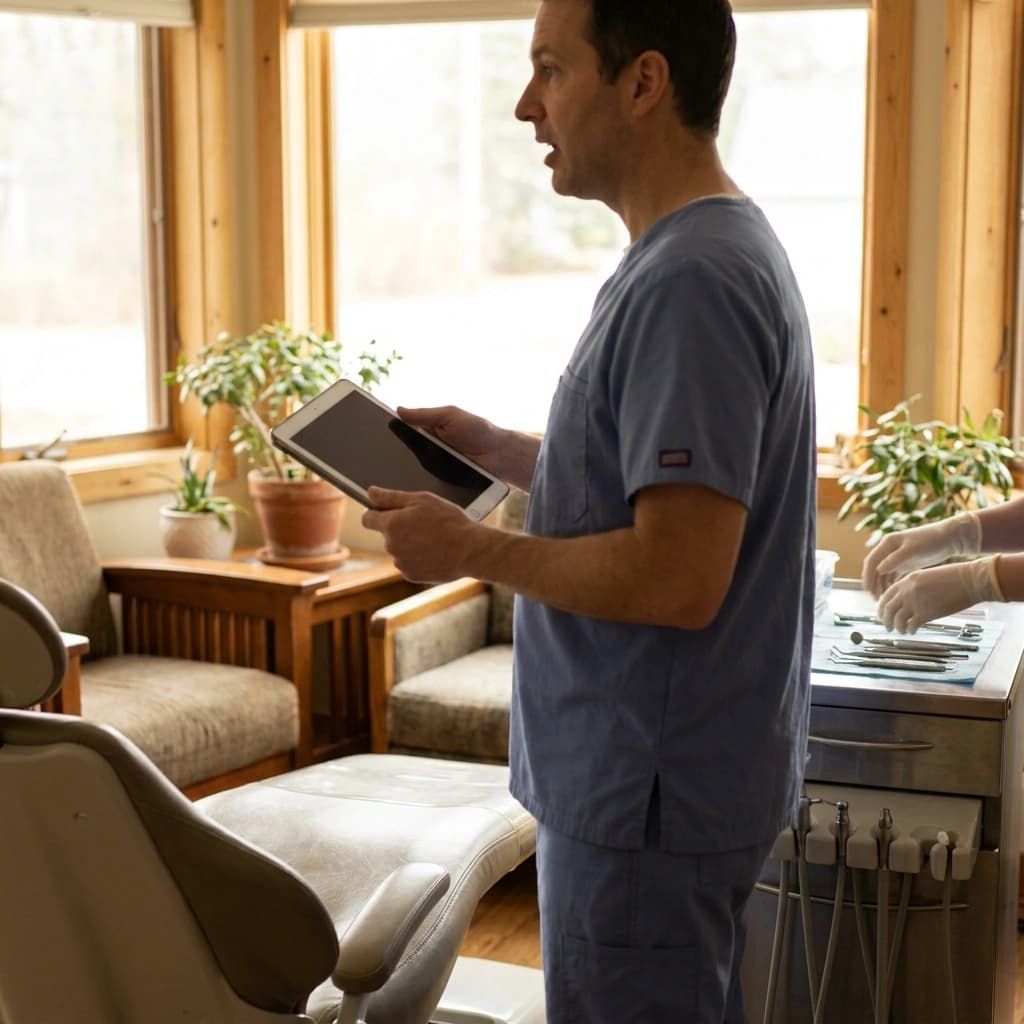
A dental AI scribe turns what happens in the operatory into the clinical note. Smile PreVue AI Clinical Notes drafts that note from what the provider dictates or types, in that provider's own writing style, and marks anything that was not said as a placeholder to confirm instead of filling it in. The dentist reviews, edits, and signs every note, then copies it into whatever practice management software the office already runs.
That claim is narrow on purpose. "Dental AI scribe" is a search term, not a product category with one shape, and the tools sold under it behave very differently once you put a patient in the chair. Three questions separate them, and none of them is about accuracy percentages.
What is a dental AI scribe, and what does Smile PreVue AI Clinical Notes do?
A scribe, human or otherwise, produces documentation of a visit so the provider does not have to write it from scratch after hours. Most software sold as a dental AI scribe does this by listening to the room and generating a note from the conversation.
Smile PreVue AI Clinical Notes works from the provider instead of the room. On the iPad in the operatory, or in a desktop browser, the provider dictates or types the raw notes. Smile PreVue drafts the clinical note in that provider's own writing style, including structure, terminology, tense, abbreviations, and sign-off.
It never diagnoses and it never plans treatment. It documents the diagnosis and the plan the dentist already made. The dentist is the author of record on every note.
It is included at $149 per provider per month, with no add-on to buy, and it runs on the same iPad already being used for the consult.
Why do only 7.4 percent of dentists use AI for charting when a third plan to?
The ADA Health Policy Institute's Q2 2026 Economic Outlook poll, fielded from invitations sent June 15, 2026 and reporting 552 private-practice dentists, found that 43.3 percent of dentists currently use AI for at least one task. Another 26.4 percent plan to. Three in ten, 30.3 percent, say they never will.
Break that out by task and charting is the strangest row in the table. Only 7.4 percent of dentists currently use AI for charting and note taking, but 34.8 percent say they do not use it and plan to. That plan-to share is the largest of any task the ADA asked about, ahead of insurance verification at 32.6 percent, billing and claims at 29.7 percent, practice analytics at 27.2 percent, and imaging and diagnostics at 25.4 percent. Among dentists who plan to adopt AI at all, 29.0 percent said they intend to start on charting during 2026.
So the demand is real and the adoption is not. The gap is trust, and the same poll shows exactly where the line sits. Asked how they feel about expanded AI use in dentistry, the second most common reaction, at 17.7 percent of responses, was that AI is a tool and should not replace clinical judgment. In the same survey, 82.6 percent of dentists said they do not use and do not plan to use AI for treatment recommendations, the highest rejection rate of any task listed. One respondent's stated reason for skepticism was simply that their existing radiograph AI is consistently wrong.
Read those together and the message to anyone building a note tool is unambiguous. A tool that quietly slides from documenting into judging fails on the first note. That is the reason for the three questions below.
Whose voice is the note in, and what happens when you did not say something?
Voice matters more than it sounds like it should. A note in someone else's template is a note you have to read carefully every single time, because you cannot skim for your own patterns. That is a tax paid on every chart, forever.
Style setup in Smile PreVue happens once. The provider adds a few past notes in whatever form they exist, PDF, Word, plain text, pasted text, or a photo of a printed note. Smile PreVue reads them, then shows a plain-language summary of the style it picked up plus a sample note. The provider confirms it sounds like them or gives feedback. There is one style per provider, and it improves from the edits that provider makes over time.
The second question is the one that separates a documentation tool from a liability. When a note usually contains something that was not said out loud during the visit, what does the software do?
Smile PreVue puts a placeholder there. Anything not dictated or typed appears as a "[confirm: ...]" line for the provider to fill in or delete. It does not infer a finding from context, and it does not pad the note toward what a complete note usually looks like. The raw transcript is always viewable, so the provider can check the draft against what was actually said.
Any team member can capture raw notes in a provider's style, which is useful when an assistant or hygienist is the one at the keyboard. The provider still reviews and signs. That separation is the point.
Where does the dictation audio go, and who can hear it?
This became the live question in 2026 for a specific reason. On April 7, 2026, a putative class action was filed in the U.S. District Court for the Northern District of California against Sutter Health, Memorial Health Services, and MemorialCare Medical Foundation, alleging that an ambient AI documentation tool recorded patient visits without clear notice that the conversation would be captured, sent outside the clinical setting, and processed by a third party. The complaint cites the California Invasion of Privacy Act, the federal Wiretap Act, and the California Confidentiality of Medical Information Act. The legal theory targets the recording itself, not what happened to the data afterward.
Provider dictation is a narrower recording surface than a microphone left open on the whole room, because what gets captured is the provider talking through the visit. Narrower is not the same as exempt. Recording and consent rules vary by state, and every practice should check its own state law and its own consent forms before recording anything. This post is not legal advice.
Here is where the audio goes in Smile PreVue. The dictation recording is saved with the patient's note, on HIPAA-compliant infrastructure running on Google Cloud under a Business Associate Agreement with Vertex AI. It plays back only for the clinic's signed-in staff, opening a recording is logged, and it is deleted when the note, the patient, or the clinic is deleted. Notes stay in the patient record inside Smile PreVue.
If you are evaluating any AI vendor that touches patient information, the vendor diligence questions in our post on signing a BAA with an AI vendor apply here too. Ask them of us as well.
Dental AI scribe comparison: ambient scribe, AI Clinical Notes, or typing it yourself
| Ambient AI scribe | Smile PreVue AI Clinical Notes | Typing it yourself | |
|---|---|---|---|
| What is recorded | The whole visit | The provider's dictation, or nothing if typed | Nothing |
| Whose voice the note is in | A template, varies by vendor | The provider's own style | The provider's own |
| Facts you did not state | Varies by vendor | A "[confirm: ...]" placeholder | Left out |
| Where the audio lives | Varies by vendor | With the patient's note, deleted with it | No audio |
| Practice software | Varies by vendor | Copy and paste into any, no integration | Native |
| Cost | A separate subscription, varies | Included, $149 per provider per month | Your evenings |
The competitor column stays generic because it has to. Ambient tools differ enormously from vendor to vendor on every row, and the honest instruction is to ask each one these questions directly rather than trust a comparison written by somebody selling against them.
The right-hand column deserves more respect than it usually gets. Typing your own notes is completely accurate, completely in your voice, and records nothing. It just costs you the evening.
Does it work with my practice software, and what does it cost?
Copy and paste, into any practice management software. Smile PreVue does not integrate with a practice management system and does not write into one, and no PMS is named as integrated. If a vendor tells you their note tool is integrated with your system, ask what that word means in their case, because it usually means something narrower than it sounds.
AI Clinical Notes is included at $149 per provider per month, or $1,199 per year. There is no separate subscription, and every provider in the practice gets their own note style. Chairside dictation on the app requires iOS version 1.2 or later, which went live in the App Store on September 8, 2026, so a practice should be on the current version. Typed notes work anywhere the app runs, and a desktop browser can dictate as well.
The note is not a separate product, and that is the reason it is worth having here rather than in another tab. Smile PreVue already runs the cosmetic consult on that iPad: the AI smile simulation in about 30 seconds, chairside pricing, and the patient paying in full or over time before they leave. Setup is about 10 minutes and there is no hardware to buy. The note is the last thing in that visit that still had to happen after hours.
If you want the full detail on how the style setup, the placeholders, and the recordings work, the hub page for AI clinical notes for dentists covers all of it.
Ready to try it in a real operatory? Start the 3-day free trial on the App Store and dictate one note in your own voice.
FAQ: dental AI scribes and Smile PreVue AI Clinical Notes
Does the AI write my notes for me? It drafts them from what you dictated or typed. You review, edit, and sign every note before it goes anywhere.
Does it diagnose or plan treatment? No. It documents the diagnosis and plan you already made. Anything you did not say becomes a placeholder to confirm, never an invented finding.
Where is the dictation recording stored? With the patient's note inside Smile PreVue, on HIPAA-compliant infrastructure under a Business Associate Agreement. Only your signed-in team can play it, opening a recording is logged, and it is deleted with the note.
Which practice management software does it work with? Any of them, by copy and paste. There is no integration with any practice management system.
Is it an add-on? No. AI Clinical Notes is included at $149 per provider per month, with nothing extra to buy.
More from the Blog
HIPAA and AI Scribes for Dental Practices: What to Ask
HIPAA and AI scribes for dental practices: the BAA, where the recording lives, who can play it back, and what to ask a vendor before you dictate a note.
Practice GrowthHow to Write Dental Clinical Notes That Hold Up
How to write dental clinical notes that hold up: what the ADA and state boards expect, SOAP structure, late entries, signatures, and where AI drafting fits.
ComplianceBAA for an AI Vendor: What Dental Practices Must Ask
A signed BAA is the floor, not the diligence. What a dental practice should verify before any AI vendor touches a patient photo in 2026.