Patients Decide With Their Eyes: The Psychology of Letting Them See the Smile First
Patients commit to cosmetic treatment when they can see the result, not just hear it described. The decision psychology behind why seeing the smile wins.
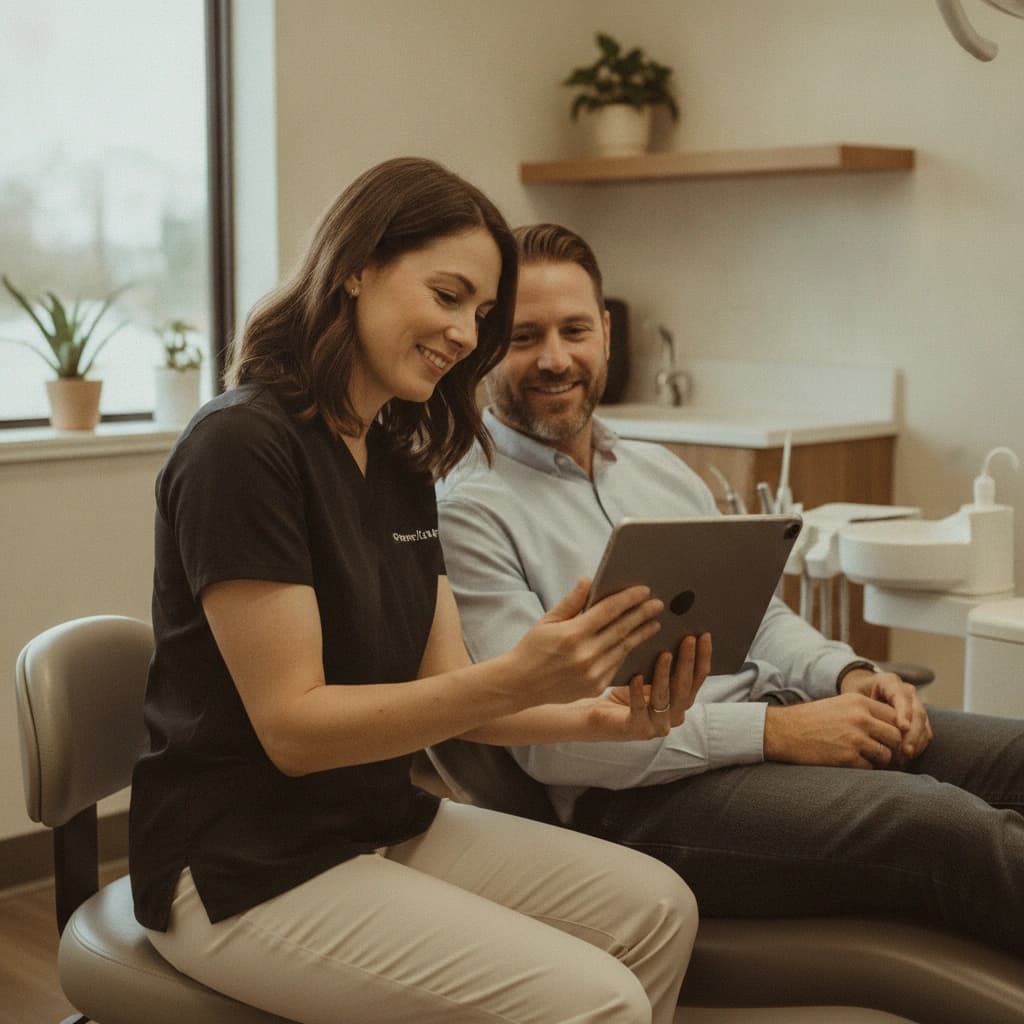
Patients rarely reject the smile itself. They reject the uncertainty of paying for a result they cannot picture. When you let a patient see the proposed outcome on their own face before they decide, you remove the single biggest source of hesitation in a cosmetic consult, and the answer often changes.
This post is about the decision psychology underneath that moment. Why seeing an outcome beats hearing it described, what the newest 2026 data says about how much previewing the result actually moves the needle, and why the patient who can see themselves is the one who says yes.
Why do patients say no to treatment they actually want?
Most cosmetic consults do not fall apart over money. They fall apart over uncertainty.
A patient sits in the chair, hears a thoughtful treatment plan, and is then asked to do the hardest thing in the whole appointment. They have to imagine a version of their own face that does not exist yet, and bet a few thousand dollars that they will like it. That is a lot to ask of anyone.
So the honest answer to "why do patients say no" is that they are not rejecting the smile. They are rejecting the gamble. The consult, as it is usually run, asks for the biggest leap of faith at the exact moment the patient has the least information to take it.
The imagination gap: what really happens in a cosmetic consult
Clinicians live inside a visual vocabulary. Shade, incisal edge, gingival margin, prep design. You can hear those words and see the finished case in your head, because you have seen a thousand of them.
A patient cannot. The same words land as noise, or worse, as risk. Their brain does not render a picture from "we will lengthen the centrals and brighten you to a BL2." It just registers that something permanent is about to happen and they cannot quite see what.
That space between what you can picture and what they can picture is the imagination gap. Every consult has one. The only question is whether you close it before you ask for a decision, or leave the patient to close it alone, later, usually by deciding not to decide.
Reference photos of other people help a little, but they introduce a new doubt. That smile looks great on that person, but will it look right on me? The gap narrows. It does not close.
Why seeing the outcome flips the decision
Two well-documented biases explain why a preview changes the answer.
The first is ambiguity aversion. People reliably decline uncertain bets even when the likely outcome is good. Faced with a known cost and an unknown result, the brain treats the unknown as a threat and defaults to "not now." A described outcome is, by definition, ambiguous. A preview is not.
The second is the endowment effect. Once a person sees something as already theirs, giving it up feels like a loss, and people work harder to avoid a loss than to capture an equal gain. When a patient sees the new smile on their own face, a quiet shift happens. The new smile stops being a purchase they are weighing and starts being something they already have and would now have to walk away from.
That is the real mechanism. You are not convincing harder. You are changing what the patient is deciding about.
The data backs this up. A 2026 analysis of AI-based digital smile design found it improved satisfaction by 58 percent for both patients and clinicians, with the ability to preview the outcome cited as the primary driver. Previewing the result was not one factor among many. It was the factor.
Seeing versus hearing: a quick comparison
Not all "showing" is equal. Here is how the three common approaches actually perform against the imagination gap.
| Approach | What the patient experiences | Does it close the imagination gap? |
|---|---|---|
| Described outcome | Clinical language about a result they cannot picture | No. The patient is still imagining alone. |
| Reference photos of other people | A great result on someone else's face | Partly. It proves the work is good, not that it suits them. |
| A preview on the patient's own face | Their own face, with the proposed smile | Yes. There is nothing left to imagine. |
The first two ask the patient to bridge the gap themselves. Only the third does the bridging for them. That is why a same-face preview behaves so differently in a consult than a binder of before-and-afters, even a beautiful one.
Why the patient who has done it before is your most likely yes
There is a second piece of 2026 data worth sitting with. Among patients who have already had cosmetic dentistry, 84.3 percent express interest in additional treatment. Among those with no cosmetic history, that number is 47.7 percent. A 37-point gap.
The first cosmetic yes is the hard one, because it is the one made across the widest imagination gap. Once a patient has lived the experience of choosing a result and loving it, the uncertainty that blocked the first decision is gone.
The lesson is not to chase the easy repeat buyers. It is to make that first decision as low-uncertainty as you possibly can, because everything downstream gets easier once a patient has crossed it once.
And the volume of those first decisions is rising. The global cosmetic dentistry market is estimated at about 35.7 billion dollars in 2026, growing at roughly 7 percent a year. More patients are walking into more consults with more high-ticket decisions to make. The practices that close the imagination gap will capture a disproportionate share of them.
What a modern visualization moment looks like
You do not need a lab, a multi-day turnaround, or a scanner to close the imagination gap. You need the patient to see the proposed result on their own face, in the room, while they still care about the question.
This is the concept-level point, not a workflow. The closer the preview sits to the decision, in both time and realism, the smaller the gap at the moment that matters. A mockup the patient sees three days later, after the emotional momentum of the consult has cooled, is a weaker lever than the same image seen during the visit.
This is the gap Smile PreVue was built to close. It generates a photorealistic preview of the patient's new smile in about 30 seconds, on an iPad, with no extra hardware, and it is HIPAA-compliant and BAA-covered so the patient's photo is handled correctly. The point is not speed for its own sake. The point is that the preview lands while the patient is still in the chair, still engaged, and still deciding.
Digital Smile Design proved years ago that visualization changes acceptance. The decision psychology simply adds that the preview is most powerful when the patient sees it same-visit, on their own face, not days later in a lab-rendered file. Speed is not a luxury here. It is part of the mechanism.
If you want to go deeper on the buying behavior behind all of this, our overview of the patient psychology of cosmetic dentistry covers the broader decision frameworks.
Frequently asked questions
How do I show a patient what veneers will look like on them? The category you want is chairside smile simulation: a tool that previews the proposed result on the patient's own photo during the visit. Reference photos of other patients help build trust, but only a preview on the patient's own face removes the "will it suit me" doubt that drives hesitation.
Does showing a preview actually raise case acceptance? The strongest 2026 data shows AI digital smile design lifting satisfaction by 58 percent for patients and clinicians, with previewing the outcome named as the primary driver. Pair that with the finding that prior cosmetic patients are far more likely to accept further treatment, and the pattern is clear. Lowering decision uncertainty is what moves acceptance.
Is it HIPAA compliant to run a patient photo through AI? It can be, when the vendor operates under a Business Associate Agreement and handles the image accordingly. Smile PreVue is HIPAA-compliant and BAA-covered, so the patient photo is processed within the right privacy posture rather than dropped into a consumer app.
Do I need new hardware to preview a smile chairside? No. A modern same-visit simulation runs on an iPad you already own. The barrier to closing the imagination gap is no longer equipment. It is whether the patient sees themselves before they decide.
See the smile before the convincing. Smile PreVue gives you a photorealistic preview in about 30 seconds, on the iPad you already have, with a 3-day free trial. Start your free trial.
More from the Blog
How to Show a Patient What Veneers Will Look Like Before You Prep a Tooth
How to show a patient what veneers will look like during the consult, and why letting them see their own result first turns a maybe into a same-visit yes.
Case AcceptanceHow to Offer Patient Financing in a Dental Practice (Without Becoming a Bank)
How to offer patient financing in a dental practice in 2026: the provider landscape, where financing fits the consult, and how it turns a price objection into a same-visit yes.
Patient PsychologyWhy Patients Hesitate on Expensive Dental Treatment: The Psychology of a $10,000 Decision
Why patients hesitate on expensive dental treatment: the psychology of a $10,000 cosmetic decision, the biases behind the stall, and what moves a yes.