Loss Aversion: The Real Force Behind a Cosmetic Case No
Patients reject cosmetic treatment out of loss aversion, the fear of regret, not just cost. Here is how letting them see the result turns a no into a yes.
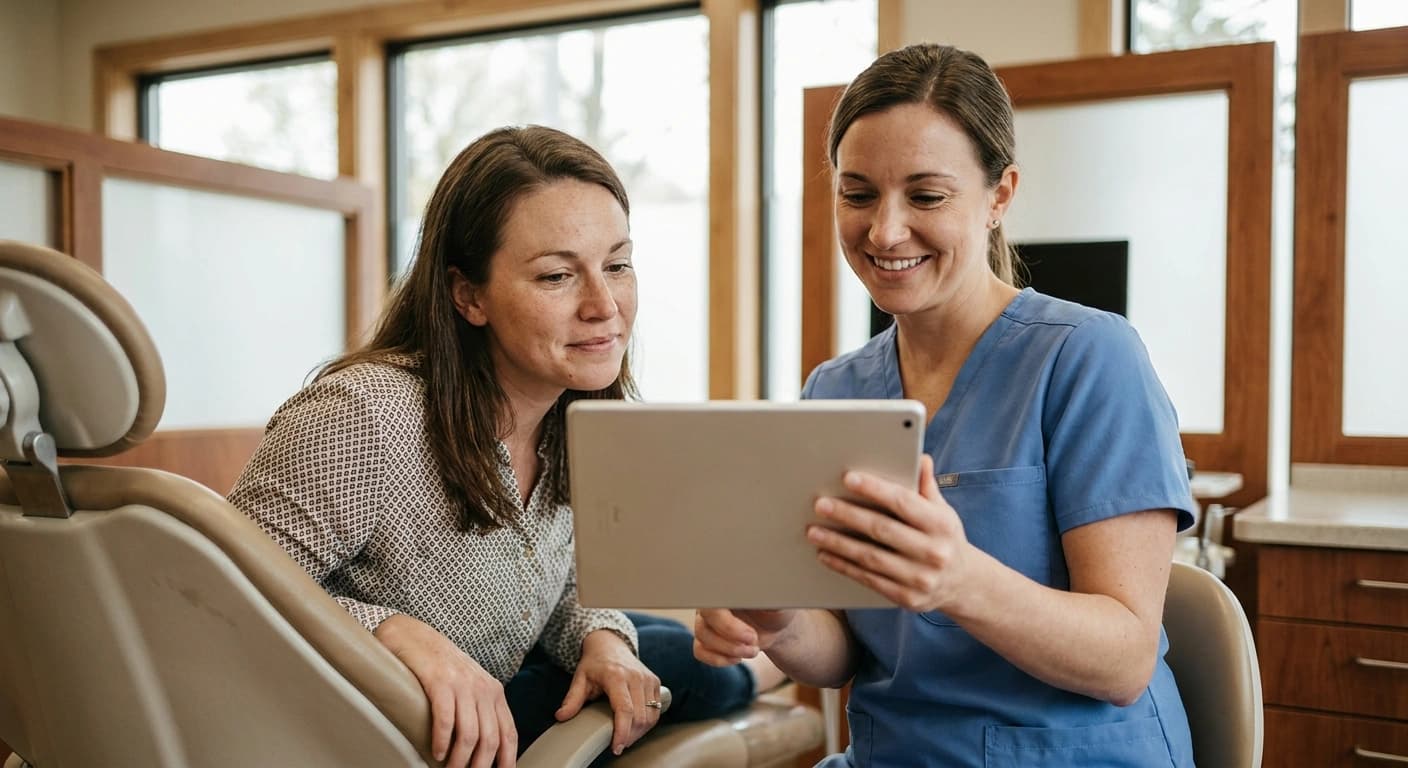
A patient who genuinely wants a better smile still says no, and the practice almost always blames the price. The real force is loss aversion. The brain treats a potential loss as roughly twice as heavy as an equal gain, so a patient facing an irreversible change they cannot picture fixates on the regret they might feel, not the smile they want.
That is why the enthusiastic consult goes quiet the moment the treatment plan lands. The number becomes the socially acceptable reason to stall. Regret avoidance is doing the actual work.
Why do patients say no to cosmetic dentistry they clearly want?
Because they are protecting themselves against a loss they cannot undo. A cosmetic case is permanent, and the patient is being asked to commit to an outcome they have only heard described. When the future is uncertain and the change is irreversible, the mind defaults to the safest move, which is to do nothing.
This shows up as a familiar pattern. The patient leans in, asks good questions, talks about their wedding or their new job, and then cools the instant fees appear. It reads like sticker shock. Underneath, it is usually a quiet question the patient never says out loud. What if I spend this money and I hate how it looks.
What is loss aversion, and why does it dominate a cosmetic consult?
Loss aversion is a core finding from behavioral economics. In the work of Daniel Kahneman and Amos Tversky, losses loom about twice as large as equivalent gains, a bias documented in their prospect theory research and popularized in Kahneman's later writing. A gain of one hundred dollars feels good. A loss of one hundred dollars feels roughly twice as bad. We are not neutral scorekeepers. We are wired to avoid loss.
A high-ticket cosmetic case is the exact situation this bias punishes hardest. It is expensive, it is permanent, and the result lives on the most visible part of the patient's body. Every one of those features raises the perceived size of the potential loss. The patient is not weighing a better smile against a fee. They are weighing a better smile against the possibility of permanent regret, and the regret side of that scale is heavier before the conversation even starts.
Is it really the money, or the fear of regret?
The 2026 numbers make the split clear. Only about 47 percent of recommended dental treatment is accepted, according to 2026 dental industry data, which makes acceptance one of the highest-return figures a practice can move. At the same time, roughly 62 percent of cosmetic dentistry spend is paid out of pocket, per 2026 cosmetic dentistry statistics.
Read those two figures together. The patient is carrying both the full cost and the full risk of the outcome. When someone shoulders both, price becomes the easy thing to point at, because price is objective and socially acceptable. Nobody feels foolish saying a treatment costs too much. Very few people will say out loud that they are afraid they will regret it.
So the practice hears a money objection and responds with money answers. More financing options. A better payment plan. A discount. Those answers address the reason the patient gave, not the reason the patient has. The case still cools, and the team concludes the patient could not afford it.
There is a simple tell that separates the two. A true money objection tends to hold steady no matter how the case is framed, because the constraint is real. A regret objection moves. It softens when the patient feels more certain and hardens when they feel pushed. When a patient who called the fee too high suddenly leans back in after seeing more of what the result would look like, the fee was never the real barrier. The uncertainty was.
How do you disarm loss aversion in the operatory?
You shrink the uncertainty. Loss aversion feeds on the unknown, so the move is to make the feared loss concrete and small instead of vague and large. When a patient can see their own future smile before a single tooth is touched, the "what if I hate it" question gets answered on the spot. The imagined regret has nowhere to live.
This is a certainty play, not a pressure play. Pressure raises the stakes and makes loss aversion worse, because a patient who feels pushed becomes even more protective of the decision. Certainty does the opposite. It lets the patient decide from a place of information rather than fear.
Timing is half of it. Loss aversion is loudest in the exact moment the patient is asked to commit, which in most practices is also the moment they know the least about how the result will actually look. That is a hard place to say yes from. Move certainty earlier in the conversation, before the plan and the fee ever come up, and the patient arrives at the decision already knowing what they are buying. The order of the consult matters as much as the content of it.
Notice what this is not. It is not a closing script, and it is not a rehearsed line for handling objections. Teaching your team the psychology matters far more than handing them words to recite. When the team understands that the real objection is regret, they stop arguing about the fee and start reducing the uncertainty, which is the thing that actually moves the decision. To go deeper on the mechanics of how patients decide, our guide to the patient psychology of cosmetic dentistry covers the wider set of biases at play in a consult.
Loss aversion versus the old present harder approach
The instinct when a case stalls is to present harder. Reframe the benefits, walk through the financing again, add urgency. That approach fights loss aversion head on, and loss aversion usually wins, because you are asking the patient to feel more confident about an outcome they still cannot see.
The alternative is to remove the uncertainty first, then let the value conversation happen on top of a decision the patient already feels good about. Here is the difference in plain terms.
| Approach | What it does | Effect on loss aversion |
|---|---|---|
| Present harder | Pushes benefits, financing, and urgency | Raises perceived stakes, deepens the fear |
| Remove uncertainty first | Lets the patient see the result before committing | Makes the feared loss concrete and small |
Legacy visualization tools sit awkwardly here. Something like Digital Smile Design produces beautiful, lab-driven mockups, but the patient waits days to see anything, and a case cools fast in that gap. The emotional peak of the consult is in the chair, not in a follow-up email a week later. The longer the patient sits in uncertainty, the more room loss aversion has to grow.
Where Smile PreVue fits
This is the unfair advantage. Smile PreVue generates a photoreal preview of the patient's own result in about 30 seconds, chairside, with no extra hardware and nothing to wheel into the room. It runs on an iPad, it is HIPAA compliant and covered by a BAA, and it puts the future smile in front of the patient at the exact moment the decision is being made.
That timing is the whole point. When the patient sees the outcome while they are still in the chair, the regret question resolves before the fee conversation even starts. You are not overcoming loss aversion with better arguments. You are removing the uncertainty it feeds on.
FAQ
Does showing a preview really change acceptance? Loss aversion predicts it should, because the bias is strongest when an outcome is both irreversible and unseen. Remove the "unseen" half and you shrink the perceived loss, which is the specific fear holding the decision back.
Is this manipulation? No. The goal is an honest decision, not a pressured one. Showing a patient their actual result gives them more information, not less, and lets them choose from clarity instead of fear. That is the opposite of a hard sell.
What does Smile PreVue cost and how do practices start? Practices can try it on a 3-day free trial and see the effect on their own patients before committing to anything.
Loss aversion is not a flaw in your patients. It is how every human brain weighs an irreversible, high-stakes decision. The practices that grow are the ones that stop fighting it and start removing the uncertainty underneath it.
See it work in your own operatory. Start a 3-day free trial of Smile PreVue and watch what happens when the patient sees the result before they decide.
More from the Blog
Why Patients Ghost After a Cosmetic Consult
Why patients ghost after a consult is rarely just price. ADA Q2 2026 data explains the silence, and what it tells you to change during the visit itself.
Patient PsychologyCosmetic Dentistry Decision-Making in 2026: The Naturalism Shift
Patients now want believable, natural results, not Hollywood veneers. Here is how the naturalism shift reshapes cosmetic dentistry decision-making.
Patient PsychologyWhy Patients Hesitate on Expensive Dental Treatment: The Psychology of a $10,000 Decision
Why patients hesitate on expensive dental treatment: the psychology of a $10,000 cosmetic decision, the biases behind the stall, and what moves a yes.