The Patient Photo Question: What HIPAA-Grade Smile Simulation Actually Means in 2026
Before you show a patient their new smile, where does their photo go? Here is what HIPAA-compliant smile simulation means in 2026, and why the answer matters.
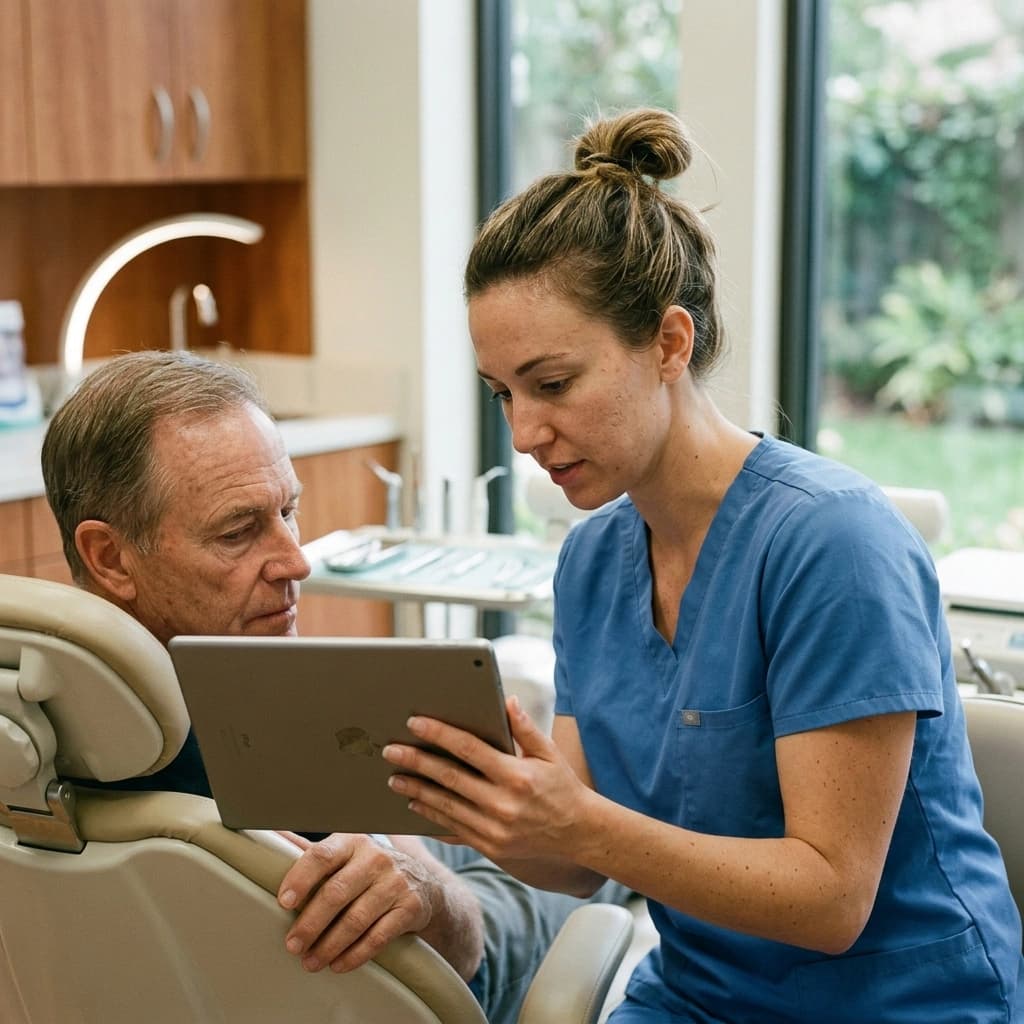
Picture the moment that closes a cosmetic case. You photograph the patient, generate a preview of their future smile, and turn the screen toward them. Their face changes. They lean in. That visual is the single most persuasive thing that happens in the operatory, and it is why same-visit yes rates climb when patients can see themselves instead of imagining.
Now rewind two seconds, to the part nobody talks about. You uploaded that patient's face to make the preview. Where did the image go? Who can see it? Is there a signed agreement that holds the vendor accountable for it?
In 2026, that quiet question has become a loud one. A patient photo attached to a proposed treatment plan is protected health information, and how it gets handled is no longer an IT footnote. It is a compliance decision, and it now sits right in the middle of the case-acceptance conversation. The most important thing to understand about HIPAA-compliant smile simulation is simple: a tool you cannot defend on privacy is a tool you cannot confidently use on your highest-value patients.
What counts as PHI when the "data" is a face
HIPAA protects individually identifiable health information. Most teams picture that as a chart, a Social Security number, or an X-ray. A photo feels different, more casual, like something off a phone.
It is not different. A facial photo linked to a proposed cosmetic procedure identifies the patient and relates to their care, which is exactly what makes information "protected" under the rule. The link between the face and the treatment plan is the part that matters.
"It is just a photo" is the assumption that gets practices in trouble. The image of a patient's smile, captured to plan veneers or aligners, is health information about an identifiable person. The moment it leaves your operatory and travels to a third-party tool, you are responsible for where it went and what happens to it there.
What changed in 2026 is not the rule. It is the attack surface. A few years ago, the only software touching a patient photo was a small set of dental-specific tools you chose deliberately. Now there is a free AI tool one tab away from every workstation, and a staff member trying to move fast can route a patient's face through it without ever thinking of it as "sending PHI to a vendor." The rule stayed the same. The number of easy ways to break it multiplied.
The free-AI-tool trap, and why it is everywhere in 2026
Here is the failure mode playing out in practices right now. AI tools are everywhere, they are easy, and a lot of them are free. Someone on the team realizes they can drop a patient photo into a general-purpose image tool and get a quick mockup. It feels efficient. It is a quiet breach waiting to happen.
Consumer AI tools commonly retain what you feed them, often to train future models, and they offer no accountability for the data once it lands on their servers. Guidance written specifically for dental offices in 2026 is direct about this. A 2026 HIPAA-for-dental guide from Pearl AI lays out the baseline expectations: business associate agreements with technology vendors, encryption in transit and at rest, and documented risk assessments. Separate 2026 guidance on AI and HIPAA from HIPAA University calls out a now-common failure directly, staff pasting protected health information into free public AI tools, and points to enterprise versions with guaranteed zero retention for training as the path that actually holds up.
Notice the shape of the problem. The shortcut is invisible. No alarm goes off when a face gets uploaded to the wrong place. The exposure only surfaces later, during an audit or an incident, when the practice has to explain where patient images went and cannot.
What a HIPAA-grade simulation tool actually has to do
If a smile preview tool is going to touch a real patient's face, it has to clear a real bar. At a concept level, that bar has three parts.
- A signed Business Associate Agreement (BAA). This is the document that makes the vendor legally accountable for the patient data it processes on your behalf. No BAA means no accountability, and no defensible answer if anyone asks.
- Encryption and access control with zero training retention. The image should be encrypted in transit and at rest, reachable only by tightly controlled access, and never retained to train a model. That last point, data minimization, is the difference between a vendor that processes a photo and a vendor that absorbs it.
- Documented handling that can pass a risk assessment. You should be able to point to how the data flows and show it stands up. Compliance you cannot document is compliance you cannot prove.
A BAA is the headline, but the other two are what give it teeth. A signature on a contract means little if the underlying system is quietly keeping copies to improve itself.
The retention point deserves a second look, because it is the one most people miss. There is a real difference between a vendor that processes your patient's image and hands back a result, and a vendor that processes it and also keeps it to make their product better. The first treats the photo as yours. The second treats it as theirs. Data minimization, processing only what is needed and keeping nothing beyond the task, is what separates an enterprise tool built for healthcare from a consumer tool that happens to accept a photo. When you ask a vendor whether images are used for training, you are really asking whose data it becomes the moment you upload it.
This is also where legacy and consumer tools tend to fall short in different ways. Established names in this space, including Digital Smile Design, built their reputations on the artistry of the preview, not on a clear, chairside-ready data-handling story. Free tools skip the question entirely. The privacy answer is rarely the thing being sold, which is exactly why you have to ask for it.
Why privacy is now part of case acceptance, not separate from it
Here is the part that turns compliance from a cost into an advantage. Patients in 2026 are privacy-aware. They have watched the headlines about AI and data. When you put a preview of their smile on the screen, a thoughtful patient is, on some level, wondering what just happened to their picture.
Being able to answer that question well is a trust lever, and trust is what closes high-ticket cosmetic cases. "Your photo is processed under a signed agreement, encrypted where it is stored, and the AI provider's terms say it will not be used to train models without permission" is a sentence that lowers a patient's guard at the precise moment you are asking them to say yes to a five-figure case. It signals that the practice is serious, modern, and careful with them specifically.
The reverse is also true. If you would not feel comfortable explaining how a tool handles a patient's face, you should not be using it on your best patients. The economics make the point on their own. The cases where the visual matters most, the full-mouth cosmetic plans, are the same cases where a privacy misstep would cost the most. You cannot afford a closing tool you have to keep quiet about.
What to ask any smile simulation vendor before it touches a patient
You do not need to become a compliance officer to protect your practice. You need a short, honest checklist and the willingness to use it before a tool ever touches a real patient photo. At a concept level, three questions do most of the work.
- Will you sign a BAA? If the answer is no, or vague, stop there. A vendor unwilling to be accountable for the data has told you everything.
- Where is the image processed and stored, and is it encrypted? You want a clear answer about enterprise infrastructure, not a shrug.
- Is the image ever used to train a model? The answer you want is a flat no, with zero retention for training.
Any vendor that handles patient data well will answer these quickly and plainly. Hesitation is itself an answer.
This is the standard Smile PreVue was built to meet. It processes patient images on enterprise AI, Google Vertex AI, under a Business Associate Agreement. Google Cloud encrypts stored data at rest by default, Google's terms for Vertex AI say customer data is not used to train its models without permission, and Smile PreVue strips a photo's embedded metadata before the image reaches the model. Our security and compliance page lays out how patient photos, AI processing, audit logs, and access are handled. The point is not the technology for its own sake. The point is that the tool which makes a patient light up in the chair is also a tool you can put your name behind, defend in a risk assessment, and use on your highest-value cases without a second thought.
The smile preview is what closes the case. The privacy answer is what lets you use it on the patients who matter most. In 2026, you need both. If you want a closing tool that clears the privacy bar by design, you can start a 3-day free trial through the App Store and see it in your own operatory.
More from the Blog
Smilecloud Pricing vs Smile PreVue: What Each Includes
Smilecloud pricing, plans and trial next to Smile PreVue's one plan, from each vendor's own pages. See which fits design work and which closes cases.
Smile Simulation SoftwareHow to Choose AI Smile Simulation Software in 2026: A Buyer's Guide for Practices That Want to Close
AI smile simulation is standard in 2026. Here is what actually matters when choosing software that lifts case acceptance, not just generates a pretty preview.
Smile SimulationHow to Show a Patient What Veneers Will Look Like Before You Prep a Tooth
How to show a patient what veneers will look like during the consult, and why letting them see their own result first turns a maybe into a same-visit yes.