Dental Sales Without Being Pushy: What Actually Works
Dental sales without being pushy starts with evidence a patient can see, not persuasion. Here is what earns trust, and what quietly destroys it.
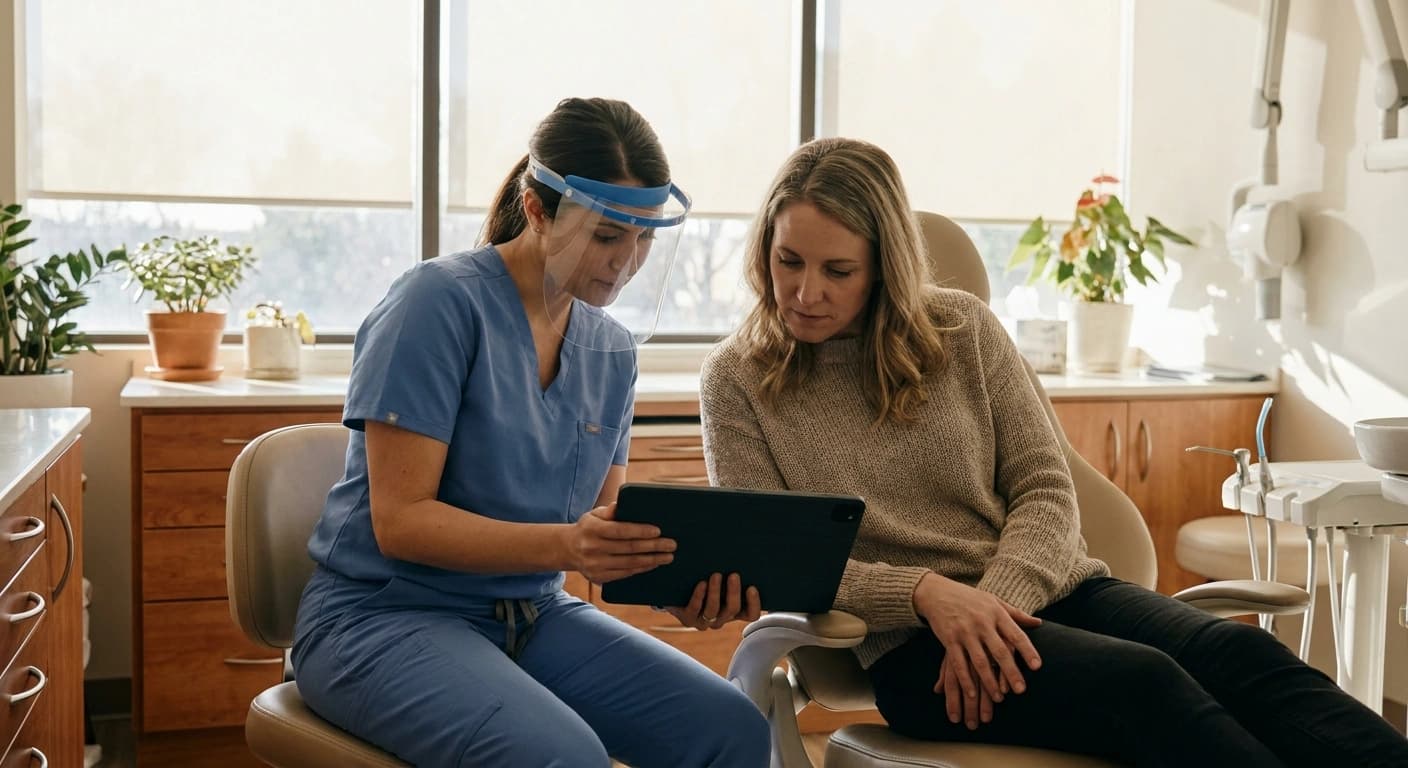
Selling dental treatment without being pushy means giving the patient enough evidence to reach the decision on their own, so the recommendation gets judged on its merits instead of on how much they happen to like you. Pushiness is rarely a tone problem. It is what a patient calls a recommendation they have no independent way to verify.
Almost every article on this subject is about delivery. Soften the language. Never say the word sell. Ask more open-ended questions. Fine advice, none of it touching the mechanism. A patient who cannot tell which part of the plan is necessary and which is optional has only one thing left to evaluate, and it is you.
What does selling without being pushy actually mean in a dental practice?
It means the patient leaves with enough information to defend the decision to themselves the next morning, in the car, to a spouse who was not in the room.
A treatment recommendation can carry evidence about three things: the diagnosis, the price, and the outcome. When all three are visible, the conversation becomes a shared evaluation. When any one of them is opaque, the patient fills the gap with a guess about your motives, and that guess runs uncharitable when the number is large.
Notice what that reframe does to the usual advice. You do not need a gentler script. You need less that the patient has to take on faith.
Why do patients feel sold to in the first place?
Because of information asymmetry, and it is not a small gap. You spent years learning to read a radiograph. Your patient is looking at a gray image on a monitor while someone describes a four figure or five figure plan.
A 2026 qualitative study in the Journal of Dental Education interviewed 25 patients aged 22 to 68 between July 2023 and June 2024 about what built and destroyed their trust in dental professionals. Roughly 52 percent based their trust on the dentist's communication and empathy, and roughly 48 percent on their perception of the dentist's technical competence. It is an interview study, not a national survey, so read it as a careful look at how patients reason.
What stands out is the failure mode the participants described. When different members of the team gave inconsistent information, trust fell apart. One participant described a hygienist saying their gums and teeth were great, followed by a dentist saying there was a lot to do. Nothing in that exchange was necessarily wrong. Both statements can be true at once. But to a patient with no way to reconcile them, it reads as a script rather than as care.
The study also found that cost cuts in both directions. Some participants read high fees as being scammed. Others distrusted a low-cost clinic outright, one recalling a filling that fell out the same day. Price alone is not a trust signal, which means you cannot discount your way out of this problem.
Distrust in that study did not usually produce an argument. It produced avoidance, or a quiet switch to another provider. That is what a pushy reputation actually costs, and you almost never get told about it.
What replaces persuasion? Evidence the patient can hold
For restorative and periodontal work, the evidence already exists and most practices under-use it. Put the intraoral photo on the screen at a size the patient can actually see. Walk the pocket depths out loud. Point at the fracture line. Say what happens if nothing is done, with a real timeframe rather than a vague warning.
None of that is a sales technique. It is showing your work, and it converts because the patient can follow the reasoning to the same conclusion you reached.
Elective cosmetic cases are the hard case, and it is worth being honest about why. There is no pathology to point at. Nobody has to fix a smile they already function with. Strip away the evidence and what remains is adjectives: brighter, more natural, more youthful. Adjectives are exactly what a pitch sounds like.
So for an elective case, the only real evidence available is the outcome itself. That is the whole argument for previewing the result before the patient has to commit. It moves the sentence from "trust me, you will love this" to "look at this with me and tell me what you think." One of those is a request for faith. The other hands the patient something to critique, including the freedom to say the veneers look too long, or too white, or not like them.
Practices worry that handing the patient something to criticize will cost them cases. It does the opposite. A patient who negotiated the shade with you is collaborating, not being sold to.
Which presentation methods actually give the patient something to evaluate?
Not every visualization method does the same job, and the honest comparison matters more than a feature list.
| Method | What the patient sees | Time in the visit | Who does the work |
|---|---|---|---|
| Verbal description only | Nothing. Adjectives and their own imagination | Minutes | The clinician, live |
| Stock before-and-after photos | Someone else's teeth and someone else's face | Minutes | Marketing, once |
| Diagnostic wax-up or mock-up | A physical, highly accurate preview | A separate appointment, plus lab time | The clinician and the lab |
| Lab-integrated digital design | A comprehensive, clinically planned case | Days, across a planning workflow | The clinician, the lab, a trained team |
| Chairside AI simulation | Their own face with the proposed result | 20 to 30 seconds, in the same visit | The AI, from a photo taken at the chair |
Read that table honestly and the conclusion is not that one row wins. A diagnostic wax-up is more clinically accurate than any screen preview and always will be. A lab-integrated workflow like Digital Smile Design is doing genuine treatment planning, coordinating the restorative and lab sides of a comprehensive case. That is a different job than what happens in the ten minutes when a patient is still deciding whether to do anything at all.
The gap those tools leave open is timing. A wax-up costs lab time and a second appointment, so it arrives after the patient has already said yes. It cannot help with the one who says they want to think about it and never comes back.
Smile PreVue exists in that specific window. It runs chairside on an iPad with no additional hardware, produces a photorealistic preview of the patient's own smile in 20 to 30 seconds across 20 or more VITA shades, and processes real patient images under a BAA on Google Vertex AI. The point is not that it replaces the wax-up. It is that the patient gets to see something before the moment where their only options are yes on faith or a polite exit. If you want the broader frame, our guide to the dental sales process covers where each of these tools belongs in the consult.
How should price come up so it does not feel like a pitch?
Early, unprompted, and in the same breath as the plan.
The cost-clarity finding in that study is the practical one. Money disclosed before the patient asks reads as transparency. The identical number disclosed after they hesitate reads as a reveal. Same figure, opposite meaning.
Payment options follow the same rule. Offered alongside the plan, financing is information. Deployed the moment a patient flinches at the total, it is a lever, and they can feel the difference.
Worth stating plainly since this is where practices get into trouble: Smile PreVue is a software platform, not a lender. Card and wallet payments run through Stripe. Pay-over-time is offered by third parties such as Affirm, Klarna, or Sunbit, and every application is subject to their approval. Never tell a patient they are approved, or imply approval is a formality. A financing promise you cannot keep does more damage to trust than the original price ever would have.
What does a non-pushy follow-up look like?
One useful artifact beats three check-in calls.
Most follow-up fails because it carries no new information. A voicemail asking whether they have thought any more about it tells the patient nothing except that you want their answer. Sending what they actually saw at the chair is a different message: here is the thing you were looking at, take your time.
That is why Smile PreVue lets a practice share the simulation and a clinic-branded before-and-after report by email, so the preview goes home with the patient instead of staying on the operatory screen. Texting is available too, rolled out practice by practice and only with the patient's documented consent, so email remains the default channel.
Then set a real cadence and stop. Two touches over a few weeks is attentive. Six is chasing, and a chased patient starts wondering why you need this so badly.
Frequently asked questions
Is it unethical for a dentist to sell treatment? Recommending indicated treatment is your job, and declining to recommend it because the conversation feels uncomfortable is its own failure. The ethical line falls between a recommendation and pressure. A recommendation survives the patient saying no.
How do I present a cosmetic case without overpromising? Say out loud that a simulation is a preview, not a guarantee, and that the final result depends on the clinical work. Patients trust the preview more, not less, when you name its limits yourself.
Should I quote the price before or after presenting the treatment plan? Present them together, before the patient asks. Cost transparency was one of the trust themes in the 2026 study, and a number that has to be pulled out of you reads as something you were hoping to avoid.
Does showing a simulation feel like a sales tactic to patients? It does when it is used to close, and it does not when it is used to decide. If the patient can change the shade, ask for something more conservative, or say they do not like it, the preview is functioning as evidence. If it only ever appears immediately before the ask, they will read it correctly as a closing device.
If the patient still says no, the evidence was real and the answer was informed, and that patient comes back. The one who felt cornered does not.
Cosmetic cases stall because the patient cannot see what they are buying. Smile PreVue shows them, at the chair, in the same visit. Start a 3-day free trial on the App Store and run it on your next consult.
More from the Blog
Dental Practice Sales Pipeline: See Every Open Case
A dental practice sales pipeline turns undecided cases into a tracked list with named stages and aging, so diagnosed treatment stops quietly disappearing.
Dental Sales ProcessThe Treatment Coordinator KPIs That Predict Case Acceptance
The treatment coordinator KPIs that actually predict case acceptance, the vanity numbers to stop tracking, and the one leading indicator you can move.
Dental Sales ProcessDental Consultation Conversion Rate: What the Consult-to-Case Funnel Actually Looks Like in 2026
Dental consultation conversion rate benchmarks for 2026: what a healthy consult-to-case rate is, why most cases stall, and the one lever that moves it.