How to Increase Dental Case Acceptance: A Practical Guide for Cosmetic Practices
Five practical strategies to increase dental case acceptance for cosmetic procedures, from consultation environment to visualization tools to follow-up cadence.
Most cosmetic dental practices accept somewhere between 40 and 55 percent of the cosmetic cases they present. That is the average. It also means roughly half of the patients who walk into your operatory interested in veneers, whitening, alignment, or a full smile makeover walk back out without scheduling treatment.
The interesting part is that low acceptance rates rarely come from price objections. They come from the moments before the price even comes up. Patients leave undecided not because the cost feels too high, but because the outcome feels too uncertain. They cannot picture themselves with the new smile, so they default to the safest option, which is doing nothing.
Here are five strategies that consistently move case acceptance for cosmetic practices, ordered roughly from highest impact to lowest.
1. Help the Patient See the Outcome
Of every lever you can pull on case acceptance, the single biggest one is closing the gap between your clinical vision and the patient's mental picture. When patients can see what their smile will look like before they say yes, the conversation changes shape entirely.
Practices that adopted in-consult smile visualization report case acceptance lifts in the 30 to 50 percent range over their previous baseline. The mechanism is not magic. It is just that "trust me, the result will look good" is a much weaker proposition than "here, this is what your smile will look like, what do you think."
Visualization tools have improved dramatically in the last few years. The current generation of AI smile simulation software runs in under a minute on an iPad, requires no special hardware, and produces realistic, conservative previews that match what you can clinically deliver. If your practice does not have one, this is the highest-leverage technology investment you can make for case acceptance specifically.
If you want to test this without buying a tool, try printed before-and-after photos of patients with similar starting smiles. The lift is smaller than personalized simulation, but the principle is the same. The further you can move the patient from imagination to evidence, the more often they say yes.
2. Fix the Consultation Environment
Most cosmetic consultations happen in the operatory, with the patient reclined in the chair, mask off, exposed. That setup is fine for clinical work, but it is hostile for the kind of decision a cosmetic case requires.
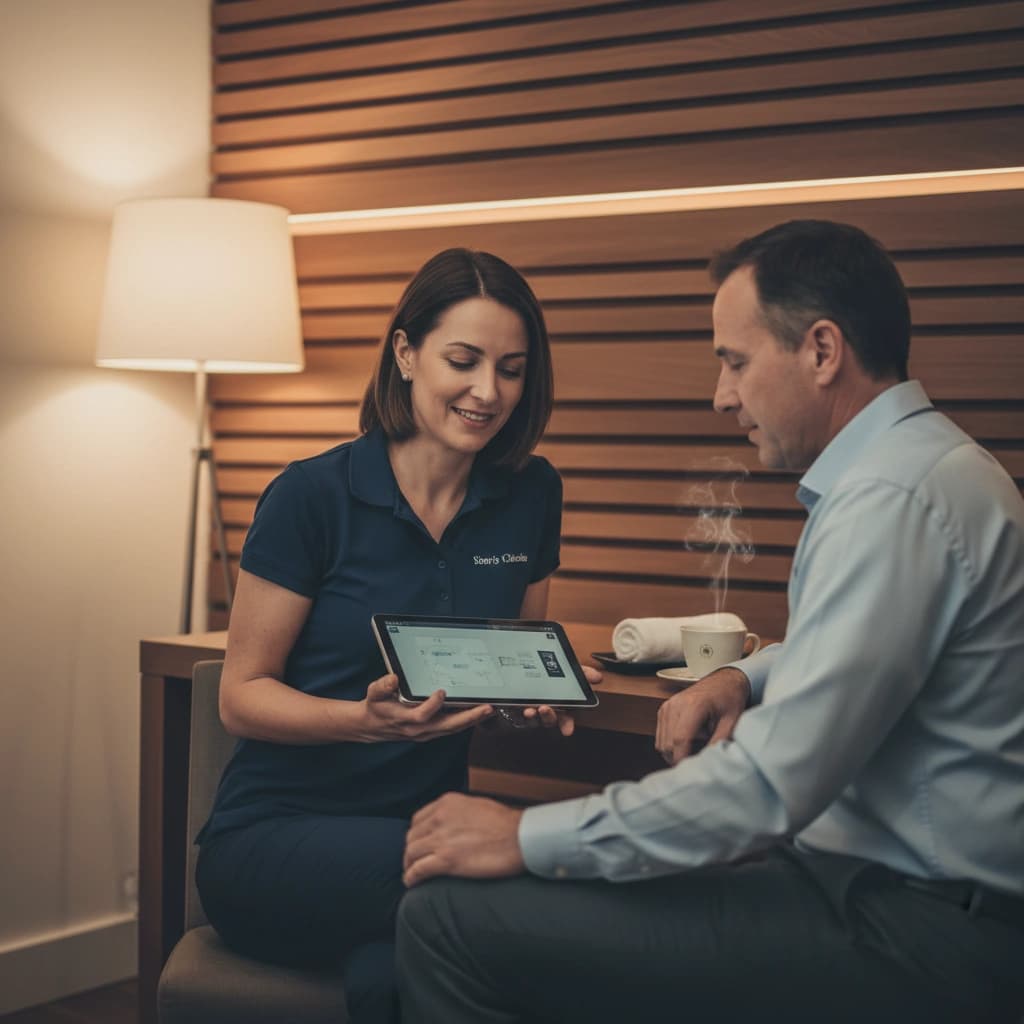
The practices with the highest acceptance rates do their cosmetic consultations in a separate room, with the patient sitting upright at a small table across from the treatment coordinator or doctor. The patient gets a glass of water. The room has soft lighting and warm wood tones. The conversation feels collaborative, not clinical.
This is not about creating a sales pressure environment. It is the opposite. A patient who feels at ease, who is not exposed in a clinical chair, who is sitting in a normal posture, makes decisions from confidence rather than from anxiety. Anxious patients default to no.
If a separate consultation room is not feasible, even small adjustments help. Bring the chair upright. Hand the patient something to drink. Sit at eye level rather than standing over them. These small shifts cost nothing and consistently move acceptance by single-digit percentage points on their own.
3. Bring Financing into the Conversation Early
Many practices wait until the end of the case presentation to mention financing. By then, the patient has already done mental math, decided the case is too expensive, and started rehearsing how to politely decline. Bringing financing in earlier short-circuits that mental loop.
Specifically, mention financing options as part of the case overview, not as a response to a price objection. Something like: "Most patients who do this case use our financing partner, which breaks it into about $X per month. I want to mention that upfront so we can talk about the case on its merits and not get hung up on the lump sum number."
This phrasing does two things. It pre-empts price anxiety, and it normalizes financing so the patient does not feel like they are signaling weakness by asking about it. Practices that moved financing earlier in their script report 5 to 10 percent acceptance lifts.
A small note on financing partners: pick one with a fast soft-credit-check approval flow, ideally one the patient can complete on their phone in 90 seconds. The longer the friction between "I want to do this" and "I am approved," the more cases evaporate.
4. Use Social Proof That Looks Like the Patient
Social proof works in case acceptance, but only when the proof feels relevant. A wall of generic before-and-after photos is less effective than three carefully chosen cases that match the specific patient's starting smile, age range, and life context.
Build a small library of consented patient cases organized by archetype: the bride before her wedding, the executive who hated their photos, the patient with mild crowding who chose veneers over orthodontics, the patient who whitened first and then did veneers. When you present a case, pull up the archetype that matches. The patient sees themselves in the story.
Video testimonials work even better than still photos when you can get them. A 30-second clip of a real patient talking about their decision and outcome shifts how the new patient processes the conversation. They are no longer evaluating a treatment plan. They are evaluating whether they want the result that another patient like them is so visibly happy about.
5. Build a Disciplined Follow-Up Cadence
The patient who walks out undecided is not a lost case. They are a delayed case, often a recoverable one. But only if your follow-up cadence is disciplined.
The minimum effective cadence is three touches over three weeks. Touch one is a same-day thank-you email with a recap of the proposed plan and the simulation if you generated one. Touch two is a follow-up call seven days later from the treatment coordinator, asking about questions that came up. Touch three is a final check-in two to three weeks later with a personalized message and an offer of a no-pressure second consultation.
Practices that follow this cadence consistently recover 10 to 20 percent of initially undecided cases. Practices that do not follow up at all leave that revenue on the table, every week. The math is unforgiving.
Automation helps but does not replace the personal touch. The best results come from automated reminders that prompt your team to reach out, combined with the actual outreach being human and specific to that patient's case. A boilerplate "just checking in" email gets ignored. A specific, warm note about their case gets a response.
Tracking What Actually Moves the Number
If you implement all five strategies and want to know which ones are working, track case acceptance by month and tag each presented case with which interventions were used. After 90 days you will have enough data to see which levers are pulling weight at your practice.
The tools and tactics that work for one practice do not always work for another. Patient demographics, market positioning, fee structure, and team dynamics all play a role. The discipline that matters is measuring, adjusting, and being honest about what is working.
A Closing Note
Case acceptance is not a sales problem. It is a confidence problem. The job is to help the patient feel confident enough about the outcome to commit. Every strategy in this guide reduces uncertainty in some specific way: visualization shows the result, environment reduces anxiety, financing addresses the math, social proof addresses the question of whether someone like them has done this, follow-up addresses the natural human tendency to defer decisions.
If you are looking for a single starting point, the visualization tool is the highest-leverage one. Smile PreVue runs in under a minute, works on the iPad your team already uses, and includes a 3-day free trial with no credit card. Start your trial and run it on your next five cosmetic consults. The acceptance numbers will tell you the rest.
More from the Blog
How to Show a Patient What Veneers Will Look Like Before You Prep a Tooth
How to show a patient what veneers will look like during the consult, and why letting them see their own result first turns a maybe into a same-visit yes.
Case AcceptanceHow to Offer Patient Financing in a Dental Practice (Without Becoming a Bank)
How to offer patient financing in a dental practice in 2026: the provider landscape, where financing fits the consult, and how it turns a price objection into a same-visit yes.
Patient PsychologyWhy Patients Hesitate on Expensive Dental Treatment: The Psychology of a $10,000 Decision
Why patients hesitate on expensive dental treatment: the psychology of a $10,000 cosmetic decision, the biases behind the stall, and what moves a yes.